ISP stages
The ISP turns a self-describing RAW frame into a display-referred
RenderedImage. It runs a fixed chain, configured by an ISPConfig preset
(src/camsim/config/presets/isp/default.json is the baseline):
RAW codes
  → DPC      defective-pixel correction
  → BLC      black-level correction and white-span normalization
  → LSC      lens-shading correction
  → AWB      auto white balance
  → demosaic CFA → RGB
  → CCM      3×3 colour-correction matrix
  → denoise  luma/chroma noise reduction
  → sharpen  thresholded unsharp mask
  → tone     exposure trim, primaries, clamp, output OETF
  → output   display-referred image + metadata
Each stage has an enabled toggle, but applicability is physical, not
configurable: AWB and CCM run only on Bayer mosaics, demosaicing is skipped
for monochrome sensors, and RCCC sensors take a dedicated baseline
reconstruction. The colour stages raise rather than guess when a required
input (for example a CCM matrix) is missing.
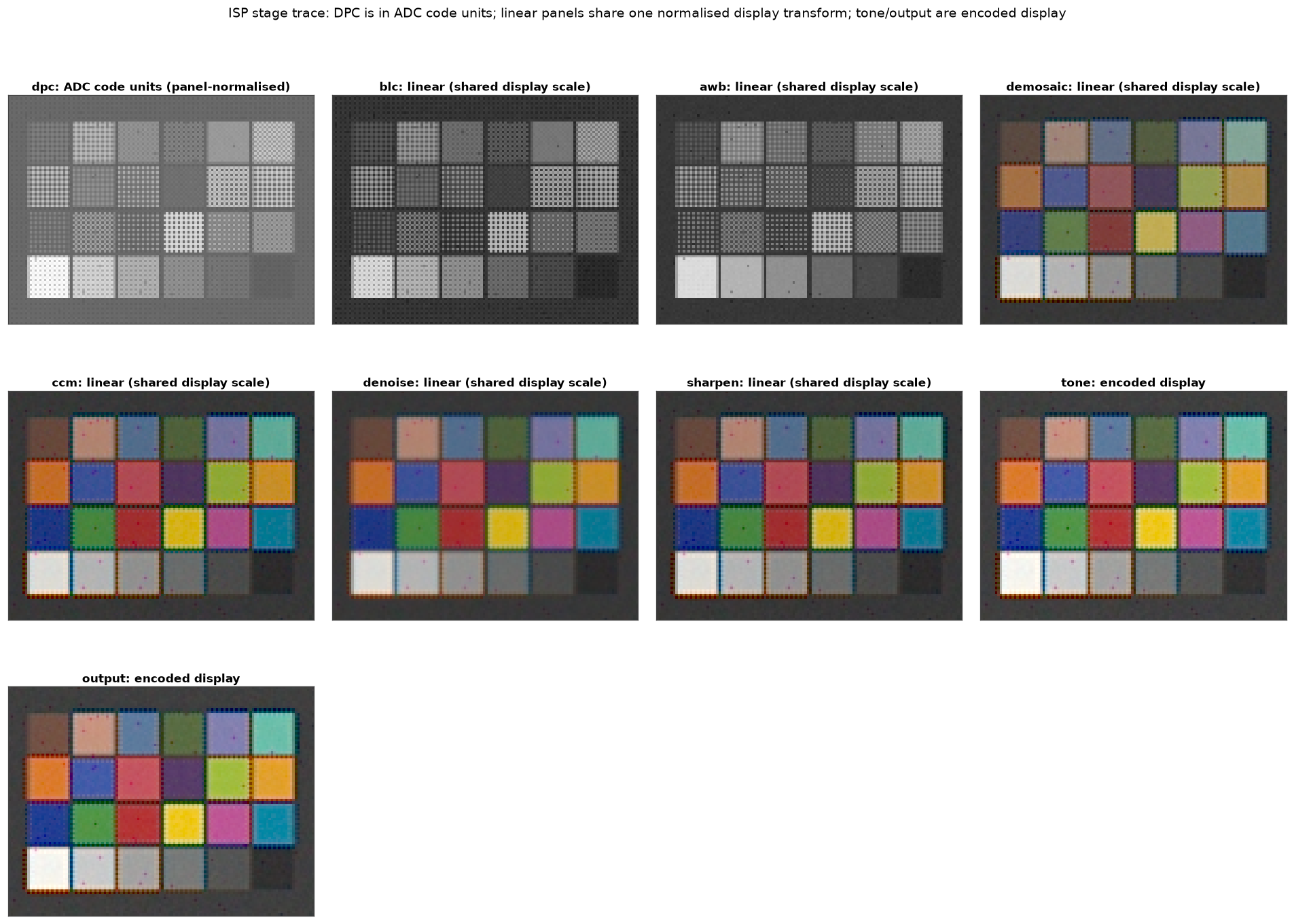
Stage-by-stage contact sheet from examples/02_isp_stage_gallery.py. Every
panel uses the same display normalization, so a black-level, white-balance, or
tone error remains visible instead of being hidden per panel.
The linear-space invariant
DPC, BLC, LSC, AWB, demosaic, CCM, denoise, and sharpen all operate on
linear float32 values proportional to radiance. The CCM output is clamped
at zero so out-of-gamut colours stay physical; that non-negativity clamp is the
one bounded exception to the invariant, and it is inactive on in-gamut data.
The ISP linearity check runs with AWB enabled and a fitted CCM and reports the
pre-clamp minimum explicitly. The tone stage is the first intentionally
non-linear step: it applies a linear exposure trim, a change of primaries when
Display P3 is selected, a display clamp, and the sRGB opto-electronic transfer
function. RenderedImage.linear_rgb keeps the matching unclipped pre-tone
buffer, while RenderedImage.data holds the display-encoded result in
[0, 1]. For Display P3, linear_rgb is in linear Display P3 primaries; the
metrics harness converts it to linear sRGB before applying Rec. 709 luma.
That split matters for measurement. Metrics that estimate resolution or noise
consume linear_rgb; only the colour metric decodes data. Handing
display-encoded pixels to an MTF or SNR estimator biases the result through the
tone curve.
Stage reference
| Stage | Config key | Main parameters | Trace metadata |
|---|---|---|---|
| Defective-pixel correction | dpc |
method: neighbor, median |
method |
| Black-level correction | blc |
on/off only | black_level_dn, white_span_dn, bit_depth |
| Lens-shading correction | lsc |
mode: none, radial, flat_field; coefficients, map, center |
mode-specific parameters |
| Auto white balance | awb |
method: gray_world, white_patch, shades_of_gray; p, gains |
gains, illuminant, method, confidence |
| Demosaicing | demosaic |
method: bilinear, mhc |
method, cfa |
| Colour correction | ccm |
matrix, ridge, row_sum |
matrix, ridge, row_sum |
| Denoise | denoise |
method: gaussian, bilateral; luma_strength, chroma_strength, radius |
same parameters |
| Sharpen | sharpen |
amount, radius, threshold, luma_only |
same parameters |
| Tone | tone |
color_space, exposure_compensation_ev, gamma |
colour space, EV, gamma, transfer |
| Output | output |
color_space, bit_depth |
colour space, channels, bit depth |
DPC — defective-pixel correction
A sensor's defect map flags dead, hot, and stuck pixels. These are physical
signal behaviours, not mask annotations: dead sites have zero mean
photoresponse, stuck sites are pinned to the ADC white code
(2**bits - 1) after digital gain, and hot sites receive a temperature-
dependent dark-current multiplier. RawFrame.defect_mask is the union of all
three; RawFrame.hot_mask preserves the hot subset. DPC replaces flagged
samples from same-CFA neighbours (neighbor) or a local median (median), in
RAW code units before any black-level subtraction. A frame without a mask is an
identity operation. Replacing a pixel from the wrong CFA phase would blend
colours; the correction is therefore phase-aware. Stuck-high is a deliberate,
deterministic convention: a real stuck site can be pinned black or white, and
the model chooses one.
BLC — black-level correction
The ADC output includes a black-level pedestal (64 DN in the flagship preset). BLC subtracts it and normalizes by the remaining white span:
linear = (code - black_level_dn) / (2**bit_depth - 1 - black_level_dn)
After BLC, every later linear stage works in [0, 1] units. ADC saturation
maps to exactly 1.0; the division is not a clip because the sensor ADC already
clipped. Disabling BLC is a diagnostic mode that leaves the pipeline in code
units and makes absolute denoise/sharpen thresholds meaningless.
LSC — lens-shading correction
Vignetting and microlens roll-off darken image corners. LSC multiplies the
linear image by a per-pixel gain from either a radial polynomial
(mode="radial", coefficients plus optional (row, column) optical centre) or
a measured reciprocal flat field (mode="flat_field"). mode="none" skips the
stage even when enabled is true, because there is no correction to apply.
Gains are dimensionless and typically 1.0 at the centre rising to roughly
1.1–1.5 at the corner for a phone lens.
AWB — auto white balance
A coloured illuminant leaves a cast because the RAW channels integrate the scene through three fixed filters. AWB estimates one gain per channel and applies the von Kries diagonal model, normalizing green to 1 so white balance changes colour, not exposure. Estimators:
gray_world— the scene average is achromatic; equalize channel means.white_patch— the brightest sample in each channel is a white surface.shades_of_gray— equalize Minkowskip-norms;p=1is gray-world,p→∞approaches white-patch, and the defaultp=6is a robust compromise.
Statistics are collected per CFA colour, never across the mosaic. AWB runs on
Bayer frames only; MONO has no colour to balance, and RCCC white balance is
deferred rather than guessed. Passing awb.gains pins known gains and skips
estimation. The recorded confidence falls as the required correction grows.
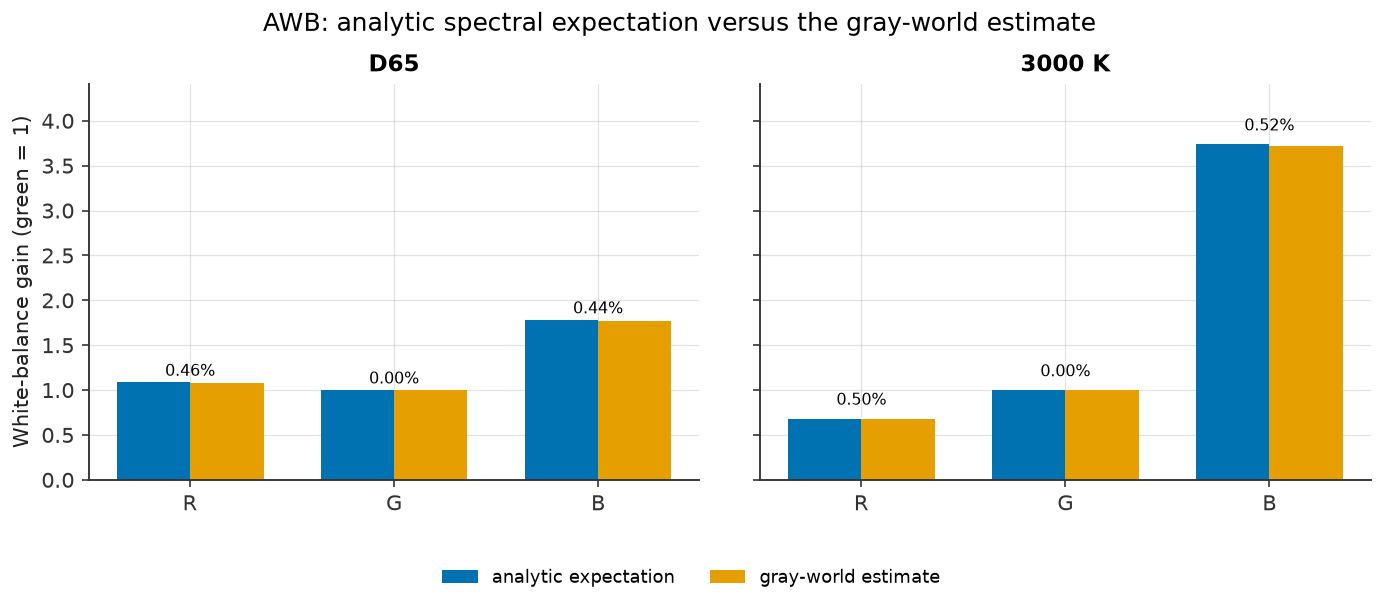
Measured gray-world gains against the analytic expectation for D65 and 3000 K; the ISP validation report states the relative-error tolerances.
Demosaicing
A Bayer mosaic records one colour per site. bilinear interpolates each plane
independently; mhc (Malvar-He-Cutler, 2004) adds a gradient-dependent
correction from the green plane and reconstructs detail with the same 5×5
support. Bilinear is faster and shows zipper and false-colour artefacts on
edges; MHC is the baseline preset's default.
RCCC sensors use a dedicated rccc_baseline reconstruction (red plus clear
sites) regardless of method. Monochrome sensors skip demosaicing entirely and
produce a one-channel image.
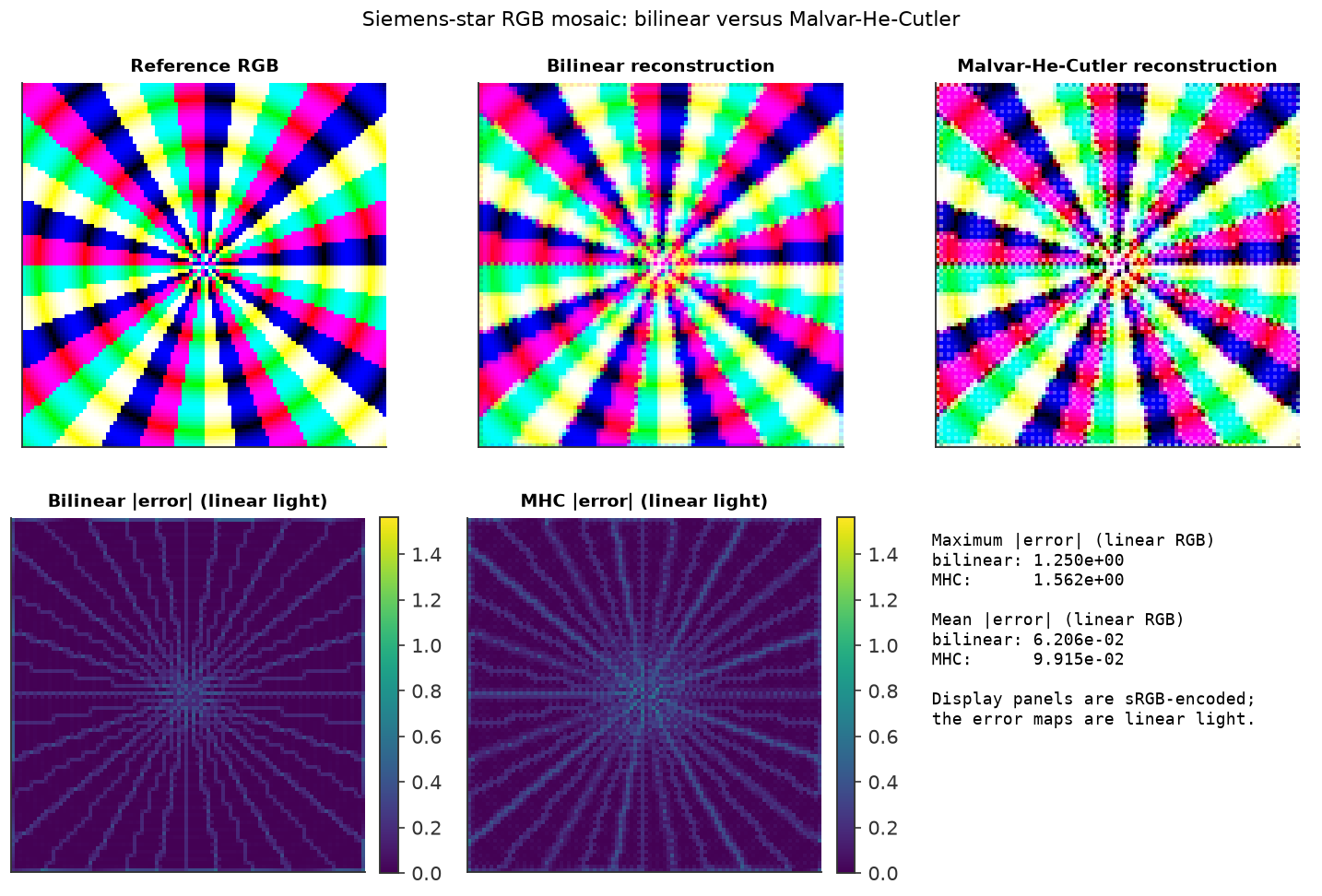
Bilinear and Malvar-He-Cutler reconstructions of a Siemens star against the full-resolution reference.
CCM — colour correction
The camera's overlapping spectral sensitivities are not a colorimetric basis.
A 3×3 matrix maps linear camera RGB to linear output RGB, fitted offline
with camsim.isp.ccm.fit_ccm under an optional ridge penalty (ridge, default
1e-4) and a row-sum constraint (row_sum) that preserves neutrals. The
pipeline never fits at runtime because it has no reference target. A Bayer
frame with CCM enabled but no matrix raises.
The shipped default preset's matrix is the identity. It is a neutral
baseline for measuring optics, sensor, and stage behaviour, not a
colour-accurate camera profile. A default ColorChecker render is roughly 40
mean ΔE2000 at the preset's default exposure (about 11 when well exposed),
while a fitted validation matrix reaches 0.9 under D65. Colour work must fit a matrix
with fit_ccm and supply it in ccm.matrix; measure_all records an
identity-CCM warning in its metadata when colour is measured through the
default. The matrix is fitted on a specific illuminant and scene, so applying a
D65 matrix to a tungsten capture or evaluating it on held-out patches measures
something other than what was calibrated; the ISP validation records the in-sample limitation.
Denoise and sharpen
Denoise works in a linear luma/chroma opponent space after demosaicing, with
independent luma_strength and chroma_strength and a Gaussian or bilateral
filter of the given radius. Zero strengths are an identity operation, which
is why the baseline preset disables the stage: measurements should reflect the
optics and sensor, not an enhancement stage.
Sharpen applies a thresholded unsharp mask. amount scales the high-pass
contribution, radius sets the blur scale in pixels, threshold suppresses
low-contrast noise, and luma_only avoids chroma fringing. Both stages are
optional and are disabled in the baseline ISP preset.
Tone and output
Tone is the only non-linear reconstruction step. It applies
exposure_compensation_ev in linear light, maps primaries to the configured
output space (sRGB or DisplayP3), clamps to [0, 1], and applies the sRGB
OETF — or a plain power curve when gamma is set. The output colour space must
agree with the tone colour space; a disabled tone stage requires sRGB output.
output.bit_depth (8–16) is metadata: it records the intended container depth
and does not change the in-memory float range or choose a file format.
save_image selects the actual depth from the requested format (8-bit PNG,
16-bit mono TIFF).
Stage traces
ISP.process(raw, trace=True) returns a RenderedImage whose stages mapping
holds one StageOutput per executed stage, in pipeline order, plus a final
"output" entry. Each StageOutput carries the intermediate array, a
human-readable description, and stage metadata; to_dict() makes the trace
JSON-friendly.
image = camsim.ISP(config).process(raw, trace=True)
for name, stage in image.stages.items():
    print(name, stage.data.shape, stage.description)
A trace is a set of immutable snapshots: later stages never mutate earlier
buffers. With trace=False (the default), RenderedImage.stages is None and
no trace arrays are allocated. The trace is the evidence behind the stage
contact sheet and the zoom crops below.
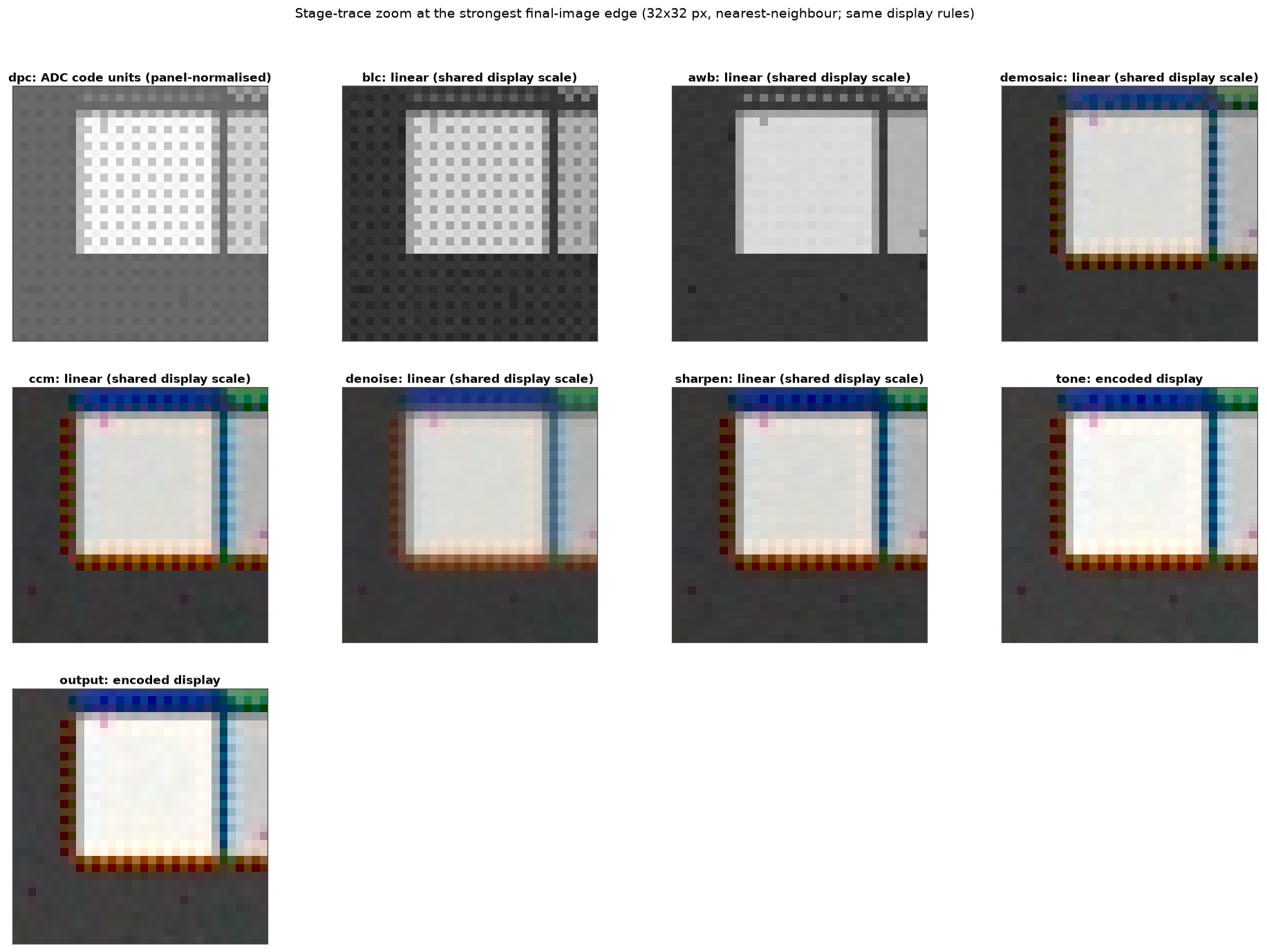
Zoomed crops of the same scene after demosaicing, colour correction, and tone, showing where detail and colour are actually reconstructed.
MONO and RCCC behaviour
| CFA | AWB | Demosaic | CCM | Output channels | Notes |
|---|---|---|---|---|---|
Bayer RGGB/BGGR/GRBG/GBRG |
yes, per CFA phase | bilinear or mhc |
yes, matrix required | (H, W, 3), RGB |
full colour reconstruction |
| RCCC | skipped | rccc_baseline |
skipped | (H, W, 3), RGB |
red plus clear sites; no Bayer CCM |
| MONO | skipped | skipped | skipped | (H, W, 1), MONO |
luminance only; colour metrics are skipped |
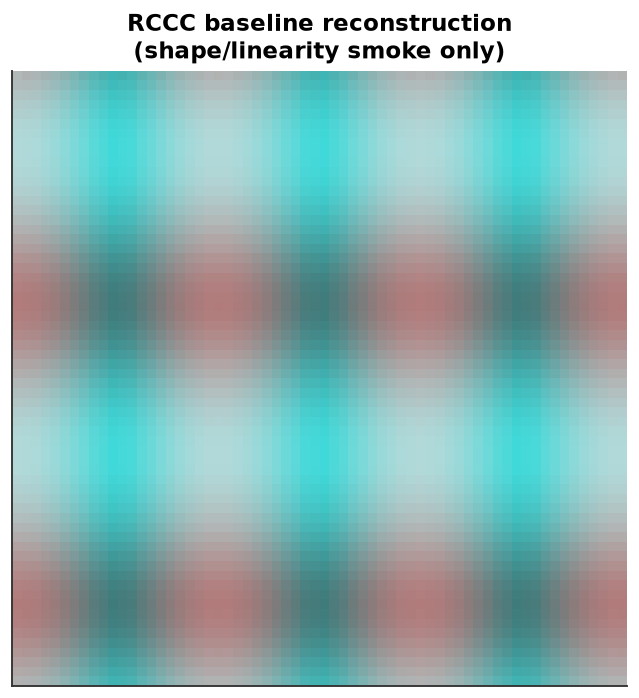
RCCC baseline output: the reconstruction is deliberately simple, and the pipeline records it as an RGB image so downstream metrics can still consume it.
Colour error after reconstruction
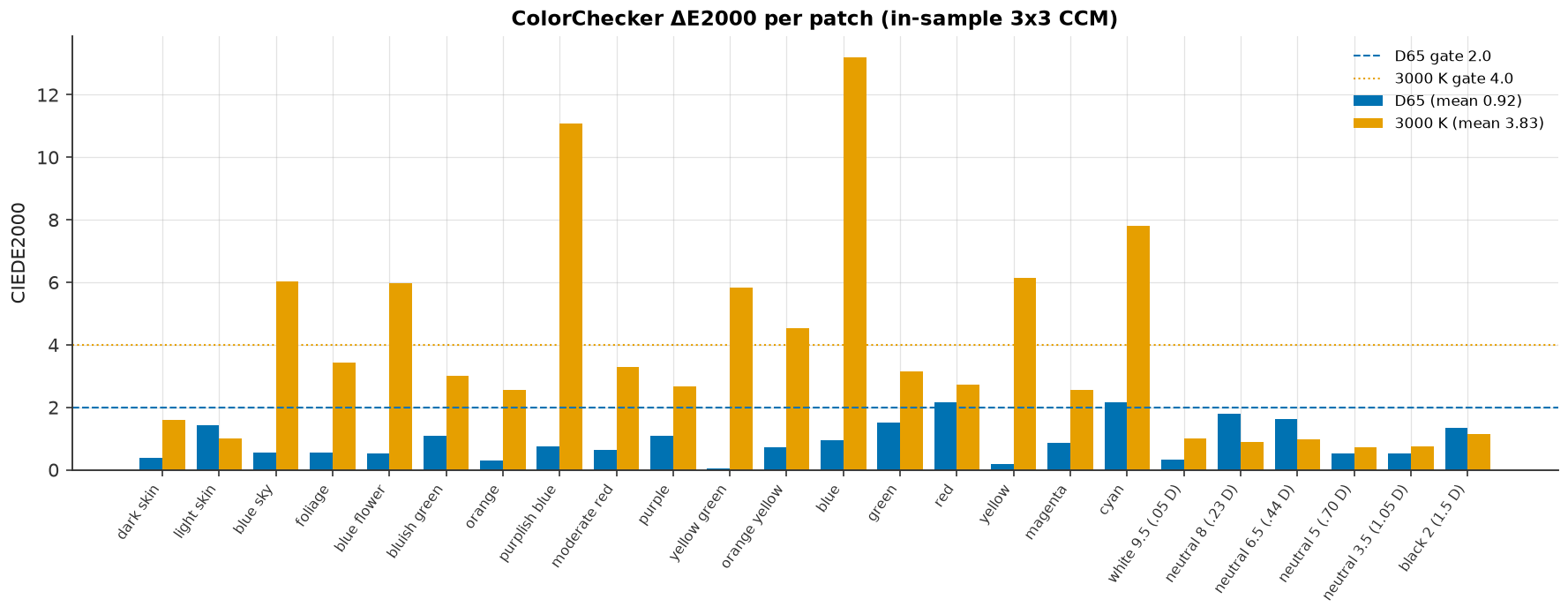
Per-patch CIEDE2000 after the in-sample 3×3 CCM at D65 and 3000 K. The metric
and its limitations are described on the Metrics page; the full
measured values are in the ISP validation report (results/reports/g3_isp.md).
Reproducing this page
uv run python examples/02_isp_stage_gallery.py
uv run pytest tests/test_isp_pipeline.py tests/test_example_02.py -v
uv run jupytext --to ipynb --execute notebooks/02_isp_color_fundamentals.py \
  --output /tmp/02.ipynb
The figures above are copies of committed files under results/figures/; the
full list and measured values are in the ISP validation report. The validation
is simulated, not a certified measurement of a commercial ISP.