Metrics
camsim.metrics is the independent image-quality harness. It operates on
arrays plus metadata and never imports camsim.sensor, camsim.isp,
camsim.scene, or camsim.optics; an import-independence test enforces that
rule. The scene layer owns convenience constructors that bind a chart to its
spectrally computed reference, and those constructors return the metrics-layer
ChartLayout, so the dependency runs scene → metrics, never the reverse.
The metrics answer four questions:
| Question | Metric | Entry point |
|---|---|---|
| How much detail survives? | e-SFR / MTF50 / MTF20 | slanted_edge_mtf |
| How noisy is a patch? | spatial and temporal SNR | snr_patch, snr_temporal, snr_channels |
| How wrong is the colour? | ΔE76 and ΔE2000 | delta_e_patches, linear_rgb_to_lab |
| How sharp is an edge? | normalized RMS gradient | edge_acutance |
Chart layouts
A ChartLayout is the measurement plan: it names the rectangular regions to
measure, an optional edge region, the camera's pixel pitch and focal length,
and, for colour charts, the per-patch Lab ground truth.
- Regions are sensor pixels, never the oversampled rendering grid; measuring the scene grid would overstate resolution by the oversampling factor.
- A
PatchROI(x, y, width, height)is half-open, matching NumPy slicingimage[y : y + height, x : x + width]. Touching regions share no pixel and overlapping regions are rejected. extract_patchreturns a view of one region without copying; metrics copy what they need.
Three constructors live in camsim.scene.charts because building a chart
layout needs reflectance spectra, an illuminant, and the CIE observer:
| Constructor | Layout | Use |
|---|---|---|
colorchecker_layout(illuminant, lens, shape, oversampling, pixel_pitch_um) |
24 named patches + Lab reference | colour difference and per-patch SNR |
flat_patch_layout(shape, pixel_pitch_um, focal_length_mm) |
one full-frame "flat" patch |
SNR, shading, fixed-pattern measurements |
slanted_edge_layout(shape, pixel_pitch_um, focal_length_mm) |
one centred half-size "edge" region |
e-SFR and acutance |
The ColorChecker layout reuses the renderer's own cell geometry and ROI
derivation at the same shape and oversampling, so a ROI never straddles a
painted patch boundary. The reference is bound to the requested illuminant
("D65", "3000K", or "4000K"); an unknown illuminant raises rather than
silently falling back to D65. Flat-patch and slanted-edge layouts carry no
reference because they measure noise and resolution, not colour.
e-SFR and MTF
A slanted edge is the ISO 12233 structure for estimating resolution from one image. The tilt lets the analysis reconstruct every sub-pixel phase of the transition; the derivative of the edge-spread function is the line-spread function, and the normalized magnitude of its Fourier transform is the MTF.
from camsim.metrics import slanted_edge_mtf

result = slanted_edge_mtf(linear_edge_plane, pixel_pitch_um=1.12)
print(result.mtf50_cp, result.mtf20_cp, result.edge_angle_deg)
Key properties:
- The input must be linear light and contain exactly one edge. A display-encoded edge is biased by the tone curve.
oversamplingis the number of analysis samples per pixel (default 4). The metrics validation uses 8 because four carries roughly a 2 % MTF50 bias for near-diffraction-limited systems.window="hamming"tapers the LSF and suppresses rectangular-window sidelobes.- MTF50/MTF20 are the first frequencies where the curve falls to 0.5 and 0.2,
in cycles/pixel;
nanmeans the curve never reaches the level inside the measured band (a legitimate answer for a very sharp system, never invented). - When
focal_length_mmis supplied, crossings are also reported in cycles/degree from the angular pixel pitch. - For a Bayer RAW frame,
extract_raw_plane(raw, "G")selects one phase and returns the pitch multiplier (2.0for Bayer,1.0for mono).
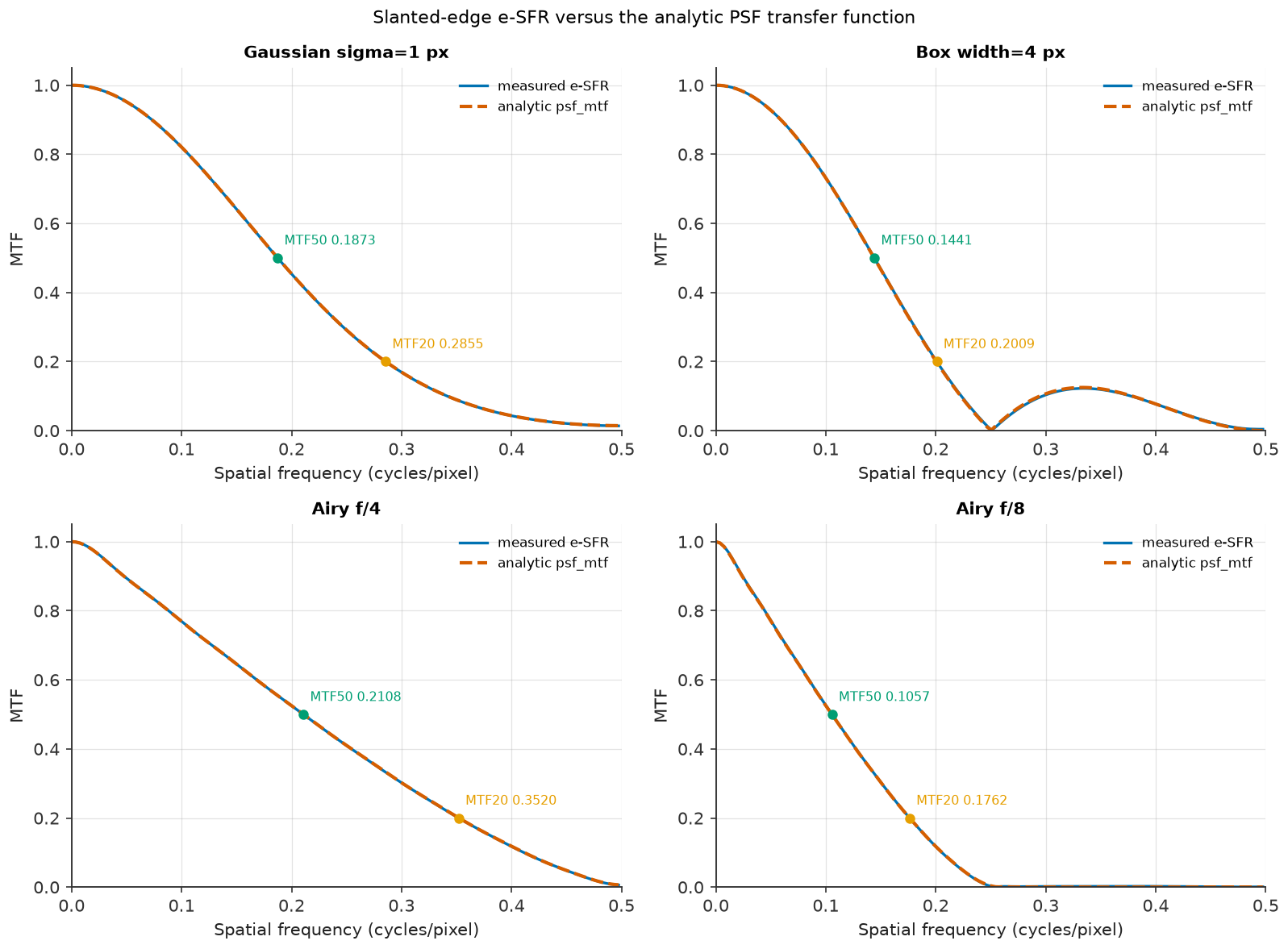
Measured e-SFR against the exact transfer function of the known PSF, with the MTF50 and MTF20 crossings marked. The analytic reference and the metric share no measurement code.
The implementation follows the standard's principles but is not a certified ISO 12233 measurement, and the input here is simulated.
SNR
SNR is reported as 20 log10(mean / std) in linear light.
Spatial SNR (snr_patch) measures one frame. It includes fixed-pattern
variation because any static pixel-to-pixel difference enters the standard
deviation. It accepts a mono or colour image and one channel (RGB plane, Rec.
709 luma, or mono).
Temporal SNR (snr_temporal) measures a stack of at least two frames of a
static scene. It pools per-pixel temporal variances, so static fixed-pattern
variation is excluded from the noise estimate while still entering the mean.
Motion, flicker, or a drifting exposure enters the variance as if it were
noise.
Per-channel SNR (snr_channels) returns R, G, B, and luma for a
colour patch, or "mono" for a single plane, in deterministic order. A flat,
black, negative-mean, or single-pixel patch reports valid=False with
snr_db=nan rather than omitting the measurement. luma is Rec. 709 weighted,
which is defined on linear sRGB primaries; a direct 3-D call assumes that
space. measure_all converts a linear Display P3 buffer to linear sRGB first
and records the coefficients and conversion in the report metadata. Applying
Rec. 709 weights directly to P3 values overstates pure P3 green and understates
pure P3 blue.
Values must be linear light with the black-level pedestal already subtracted: the pedestal raises the mean without changing the std and therefore inflates SNR.
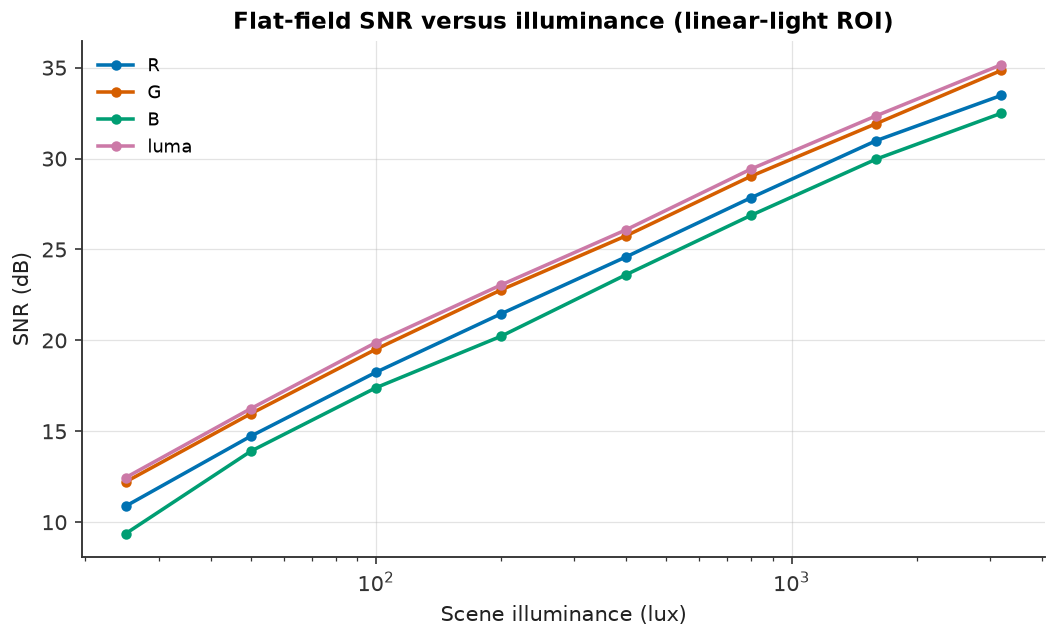
The shipped sensor and ISP at fixed exposure from 25 to 3200 lux, showing the transition from read-noise-limited to shot-noise-limited behavior. The sweep is a gallery illustration, not a metrics validation check.
Colour difference
delta_e_patches measures CIEDE2000 and CIE76 between a display-encoded image
and a reference. The pipeline is: validate the display image, decode it with
the exact sRGB EOTF, average each patch in linear light,
linear_rgb_to_lab with the reference white point (Bradford-adapting from the
display's D65 white), then compare with the matching reference row.
A reference is mandatory. When none is attached to the layout, the metric
raises for a colour-chart layout; there is no implicit D65 fallback, because a
reference that does not match the illuminant turns a white-point error into an
apparent sensor colour error. ColorReference lives in camsim.core.color, so
the scene layer can compute it spectrally and the metrics layer can consume it
without importing the scene.
The default ISP preset is not colour accurate
The shipped default.json carries an identity CCM. It is a neutral
baseline, not a calibrated colour profile: a default ColorChecker render is
roughly 40 mean ΔE2000 at the preset's default exposure (about 11 when well
exposed). Fit a matrix with camsim.isp.ccm.fit_ccm and supply it in
ccm.matrix before treating delta-E as camera colour accuracy.
measure_all adds an explicit warning to
MetricReport.metadata["warnings"] when colour is measured through an
identity matrix.
delta_e_patches returns per-patch rows plus the means over valid patches and
a validity flag. ΔE76 and ΔE2000 are both always computed, so a report can
compare the perceptually uniform metric with the simpler Euclidean one.
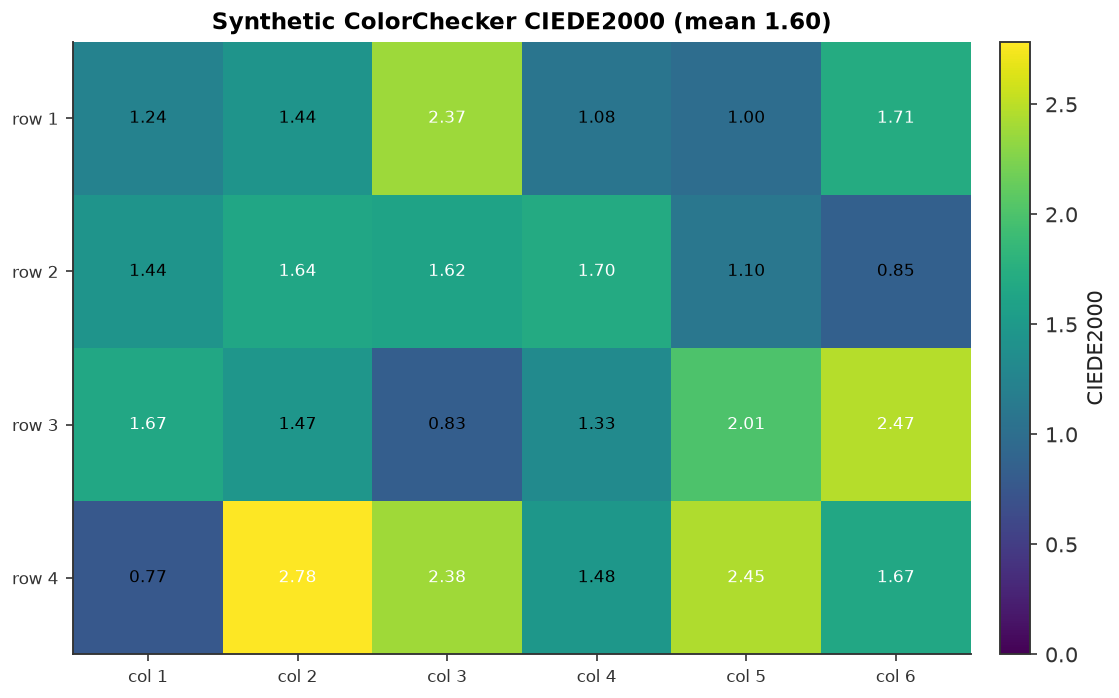
Per-patch ΔE2000 for a synthetic ColorChecker-like measurement vehicle. The chart is built from the spectrally computed reference plus a deterministic perturbation; it is not a camera render and its ΔE is not a camera colour-accuracy claim.
Acutance
edge_acutance(image, roi) is the contrast-normalized RMS gradient of one edge
ROI: it reduces RGB to Rec. 709 luma, maps the profile to [0, 1], and returns
sqrt(mean(gx**2 + gy**2)). Higher is sharper, and the normalization makes it
invariant to exposure and chart contrast. Like luma SNR, the weights assume
linear sRGB; measure_all converts a Display P3 buffer first.
It is a correlation-study sharpness proxy, not a calibrated physical quantity and not a standard definition. Its magnitude depends on ROI size, and noise, compression, and sharpening halos all raise it. Use e-SFR for a resolution measurement.
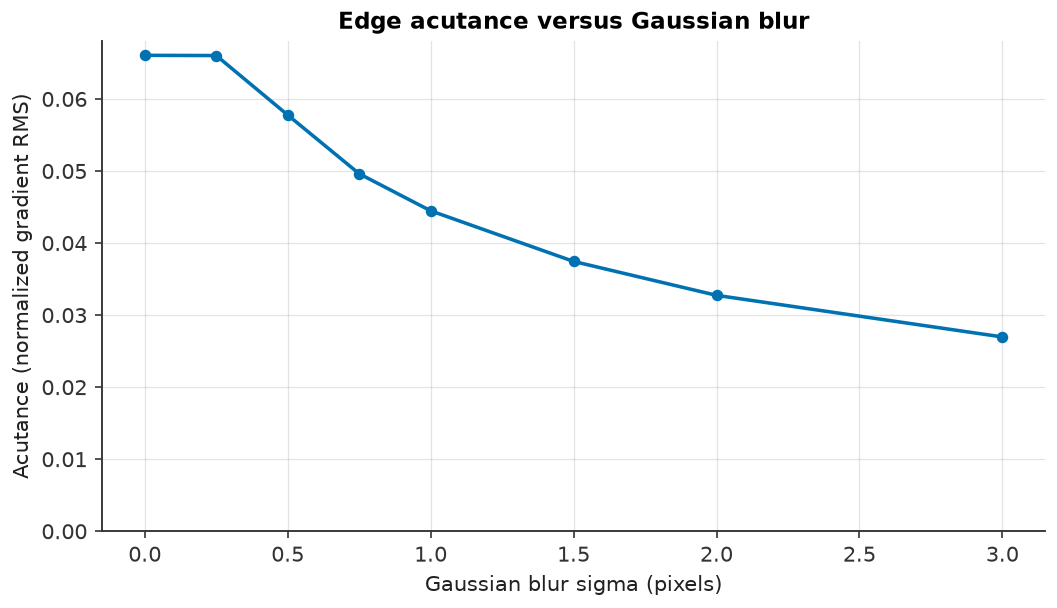
Acutance falls as a Gaussian blur widens. The curve is monotonic but not a calibrated MTF.
The unified harness
measure_all(image, layout, reference=None) measures every group the image and
layout support and returns a frozen MetricReport:
mtfandacutancewhen the layout has anedge_roi;snrper patch when the layout has patches (per channel and luma for RGB, one plane for MONO);colorwhen the image is RGB, the layout has patches, and a reference is available.
Groups that do not apply are None, and metadata["skipped"] records the
reason in a fixed order (MTF, acutance, SNR, colour), so repeated measurement
is deterministic. Resolution and noise consume RenderedImage.linear_rgb when
present; colour decodes RenderedImage.data. The metadata also records the
luma space and coefficients, the Display P3-to-sRGB conversion when one was
applied, and a warnings list (including identity-CCM colour measurement).
Neither the image nor the layout is modified.
The expected companion layout for a rendered slanted edge is
slanted_edge_layout(shape=...); for a rendered scene, prefer
chart_layout_from_scene(scene), which derives the patch/edge geometry and
reference from the SceneResult so the shape and oversampling cannot drift.
colorchecker_layout(illuminant=..., shape=..., oversampling=...) remains
available when the layout must be built independently.
JSON reports
MetricReport.to_dict() expands the nested dataclasses into a JSON-friendly
mapping; to_json() serializes it with allow_nan=False, converting NaN
crossings and undefined ratios to null. NumPy scalars and tuples become plain
Python values. The committed metrics validation payload,
results/reports/g4_metrics_results.json, is not a serialized MetricReport;
its measure_all.serialization section records the serialization checks as
booleans.
report = measure_all(image, layout)
text = report.to_json()
print(report.layout_id, report.metadata["skipped"])
Import independence
camsim.metrics may depend on camsim.core and on nothing else from the
simulator. tests/test_metrics_independence.py imports the package in a fresh
subprocess and asserts that camsim.sensor, camsim.isp, camsim.scene, and
camsim.optics are absent from sys.modules. The scene-owned layout
constructors are the sanctioned bridge in the other direction.
Reproducing this page
uv run python examples/03_measure_iq.py
uv run pytest tests/test_metrics_mtf.py tests/test_metrics_snr.py \
  tests/test_metrics_color.py tests/test_metrics_summary.py \
  tests/test_metrics_independence.py tests/test_example_03.py -v
uv run jupytext --to ipynb --execute notebooks/03_measuring_iq.py \
  --output /tmp/03.ipynb
The figures above are copies of committed files under results/figures/. The
measured values, tolerances, assumptions, and limitations are in the metrics
validation report, results/reports/g4_metrics.md (a repository artifact, not
a page on this site).
Limitations
- This is a simulated validation. The e-SFR follows ISO 12233 principles but is not certified against the standard, and the sensor/ISP numbers come from a representative engineering preset, not a commercial part.
- The analytic MTF references are ideal Gaussian, box, and Airy kernels: no aberrations, field-dependent blur, or wavelength-dependent PSF.
- The SNR gate cases use Gaussian noise in linear light, not Poisson shot noise from the sensor, to isolate the estimator from the sensor model.
- An ideal synthetic edge has no finite MTF50/MTF20; the report records
nulland never invents a crossing. - The synthetic ColorChecker-like chart is a measurement vehicle, not a camera render; colour-metric results on it are not a camera colour-accuracy claim.
- Acutance is a relative sharpness proxy; compare only measurements with the same ROI geometry.