Validation
This page is the public index of camsim's validation evidence. The
sensor/ISP/metrics core is validated and released, with committed reports for
the scene/optics, sensor, ISP, and metrics areas and a consolidated report at
results/reports/validation_report.md. Every validation area is reproducible
from a clean checkout, and the measured values, tolerances, assumptions, and
reproduction commands are recorded below.
Lines of evidence
The validation draws on four independent lines of evidence, so a bug must survive more than one perspective before it can hide:
- Analytic invariants — units and dimensional consistency, energy conservation, linear electron scaling with lux and exposure, Poisson variance in the shot-noise regime, clipping at full well and ADC saturation, known-PSF MTF, the sRGB OETF, and colour-difference identities.
- Round-trip characterization — configure known sensor parameters, run EMVA 1288-style characterization, and recover the parameters within a stated tolerance.
- Reference-library cross-checks — bilinear and Malvar-He-Cutler
demosaicing against
colour-demosaicing; colour transforms and ΔE againstcolour-science; filtering againstscipyandscikit-image. - Datasheet plausibility — the flagship preset reproduces SNR, dynamic range, full well, and read noise within the ranges implied by public specifications, with assumptions listed explicitly.
Tolerances are stated per check in the validation report. Determinism is promised within one environment (same OS, Python, NumPy, and SciPy); cross-platform comparisons use tolerances because floating-point reduction order may differ.
Validation status
| Area | Scope | Evidence | Measured / passed | Status |
|---|---|---|---|---|
| Build and test | install, lint, typecheck, tests, docs build | this page; .github/workflows/ci.yml |
11/11 commands | PASS |
| Scene and optics | scene, illuminants, optics | results/reports/g1_scene_optics.md |
7/7 checks | PASS |
| Sensor and characterization | sensor model and EMVA characterization | results/reports/g2_sensor.md + g2_sensor_results.json |
16/16 checks | PASS |
| ISP | ISP stages and pipeline | results/reports/g3_isp.md + g3_isp_results.json |
21/21 checks | PASS |
| Metrics | metrics harness | results/reports/g4_metrics.md + g4_metrics_results.json |
31/31 checks | PASS |
| Consolidated | cross-cutting evidence | results/reports/validation_report.md |
16/16 cross-cutting checks | PASS |
Coverage policy
The coverage gate enforces at least 90 % statement and branch coverage with:
uv run pytest --cov=camsim --cov-fail-under=90
pyproject.toml configures [tool.coverage.run] with an explicit omit for
*/camsim/viz/*. The presentation layer is plotting code: it is exercised by
the example scripts and notebooks that generate the committed gallery, not by
the unit suite. Its correctness is judged by executed examples, while the
simulation, metrics, configuration, characterization, IO, camera, and CLI
modules — the code whose numbers the validation depends on — must meet the 90 %
threshold. The same command is the Makefile coverage target and the CI test
command; a release must not lower the threshold or delete tests to pass it.
Coverage is reported with two explicit scopes, never one headline number:
| Scope | Measured | Threshold |
|---|---|---|
| Subject modules (viz omitted, branch) | 91.73 % | ≥ 90 % |
Whole package including camsim.viz (branch) |
83.55 % | reviewed exception |
The whole-package figure is measured with coverage-whole.rc (or
make coverage-whole), which does not omit viz. It is lower because the
plotting layer is exercised by the executed examples and notebooks, not by the
unit suite. The numerical modules meet the 90 % threshold; 91.73 % is not called
"total coverage".
tests/test_docs_smoke.py additionally checks that the README gallery paths,
documentation nav, docs/images mirror, API/release pages, and workflows exist;
that the documented quickstart pipeline runs; and that the benchmark's
--quick mode passes.
Validation figures
The documentation site carries copies of selected committed figures so each
validation area is visible without leaving the site. The originals and the full set live
under results/figures/; the reports carry the measured values and
tolerances.
| Area | Figure |
|---|---|
| Scene and optics | 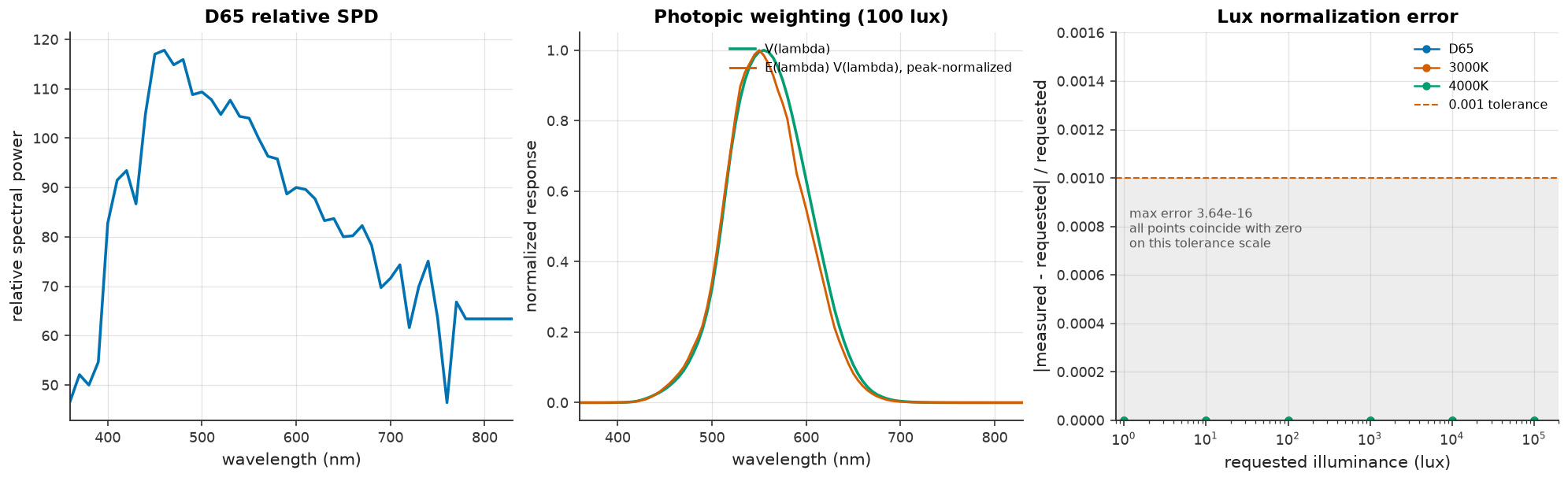 Lux normalization across illuminants and 1–100,000 lux. |
| Scene and optics | 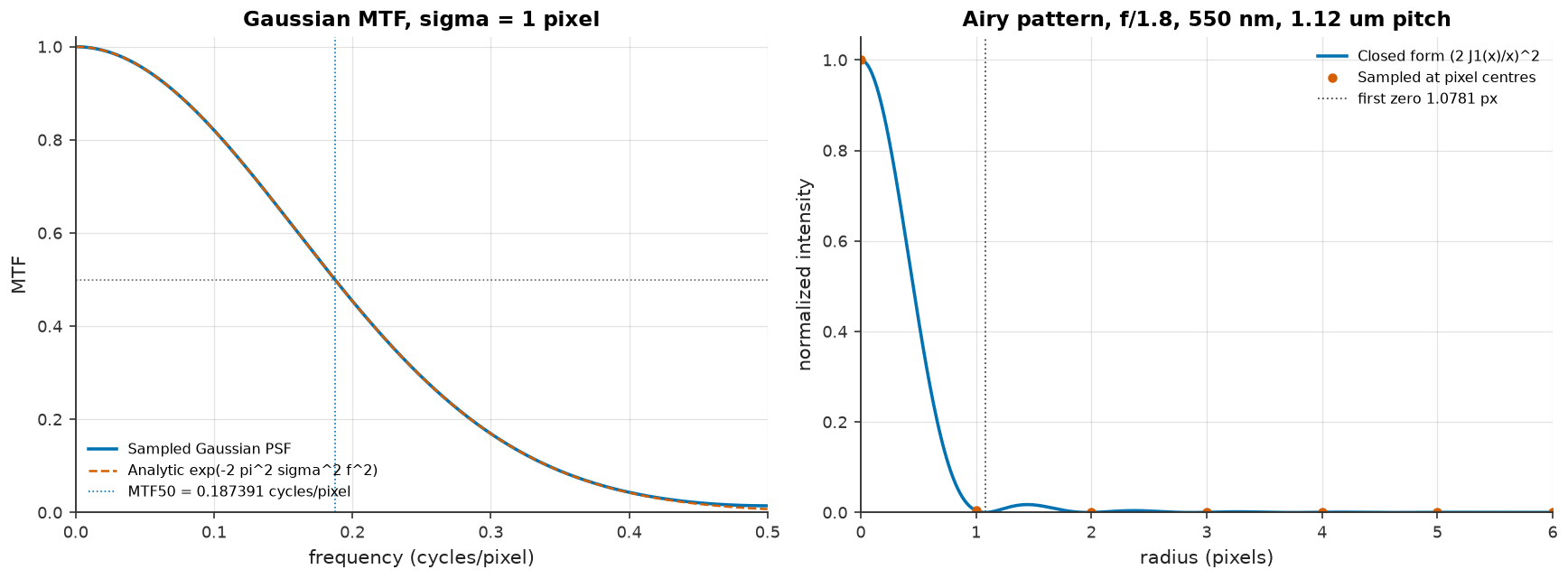 Gaussian, Airy, and box PSFs with their transfer functions. |
| Sensor and characterization | 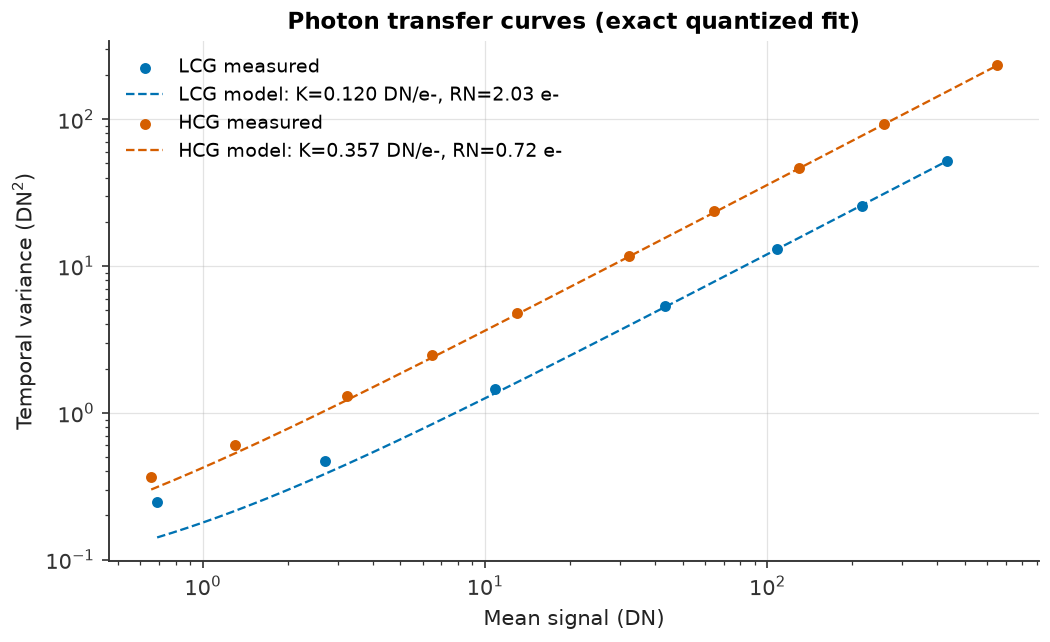 LCG/HCG photon-transfer curves and system gain. |
| Sensor and characterization | 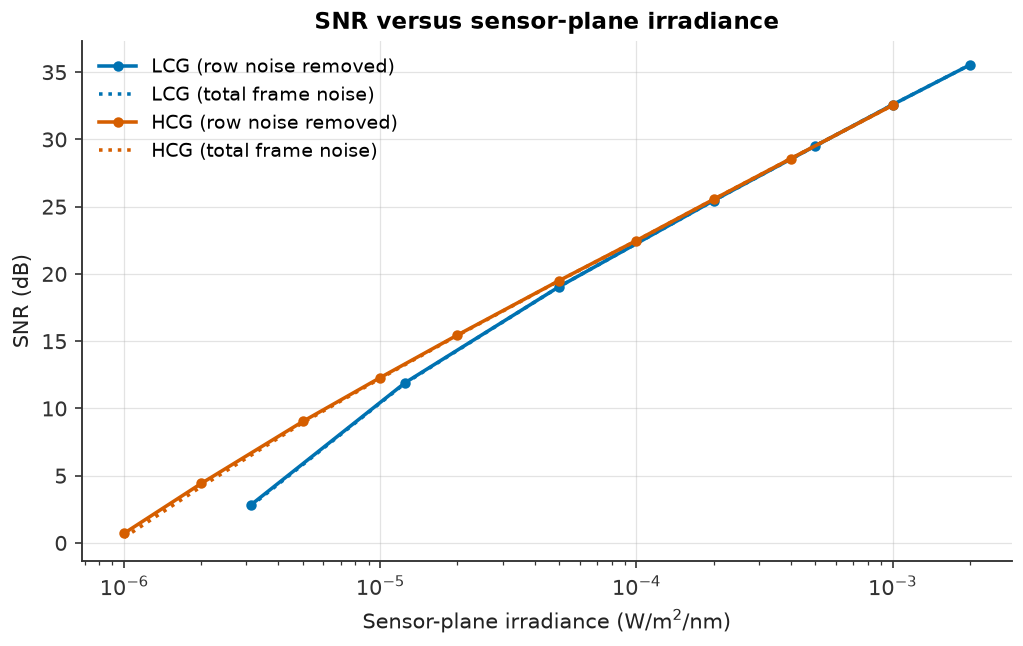 SNR versus irradiance across the shot- and read-noise regimes. |
| ISP | 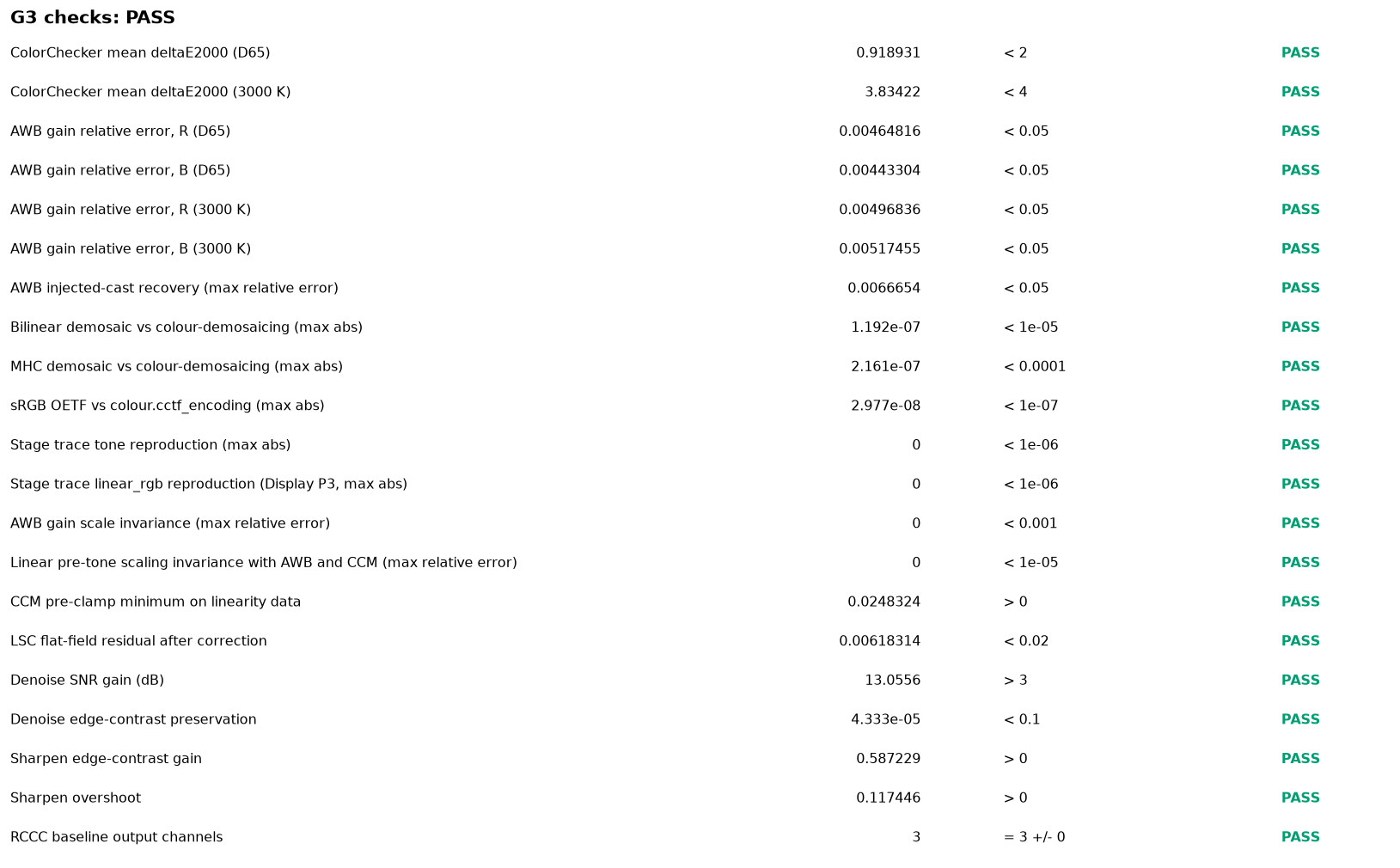 ISP check summary with tolerances. |
| Metrics | 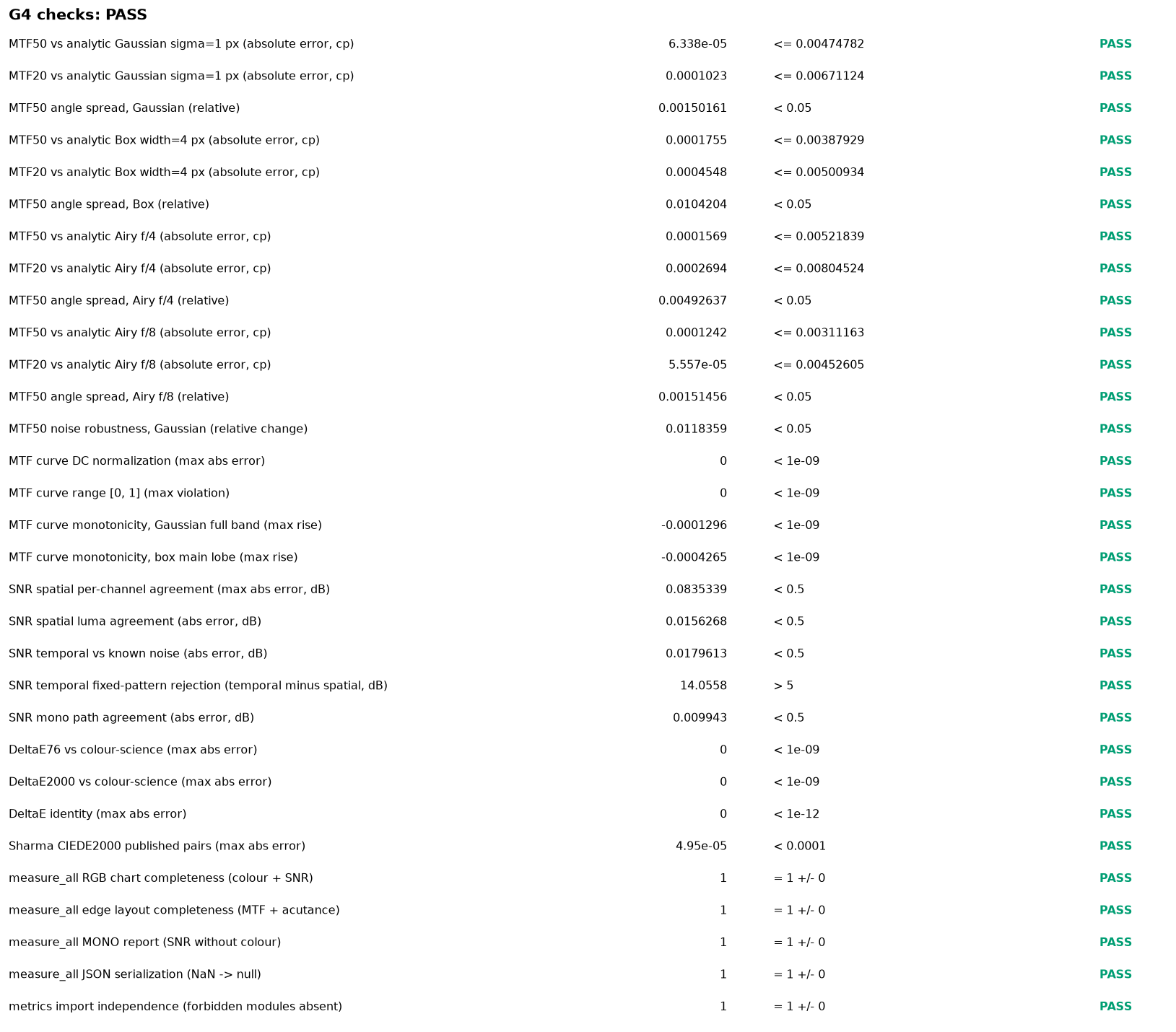 Metrics check summary with analytic references. |
| Consolidated | 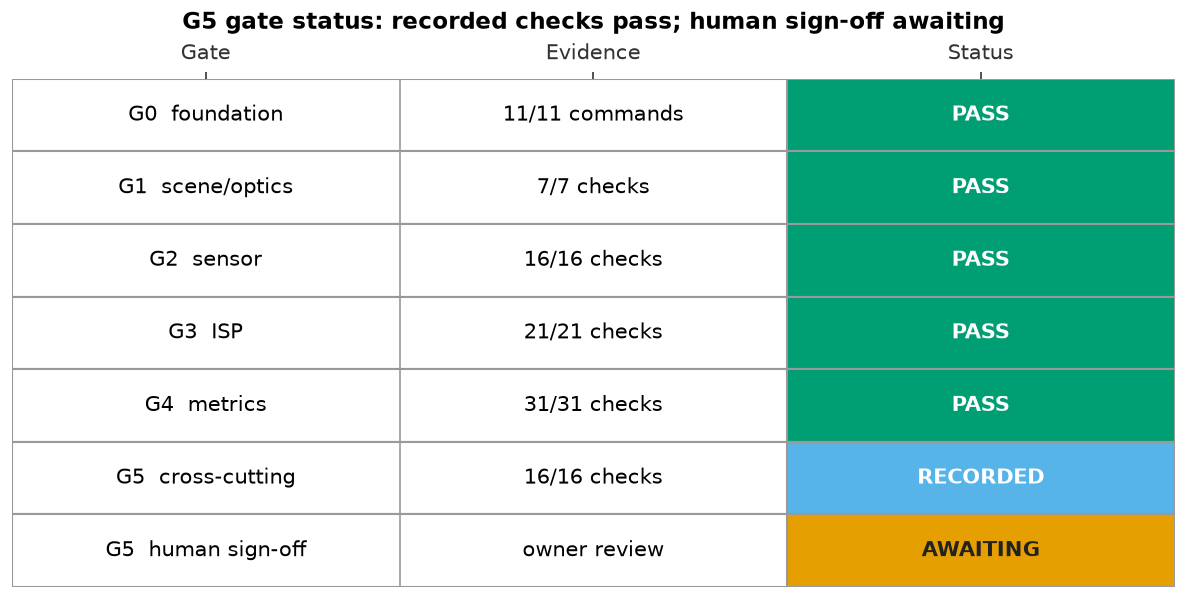 Validation status matrix. |
| Consolidated | 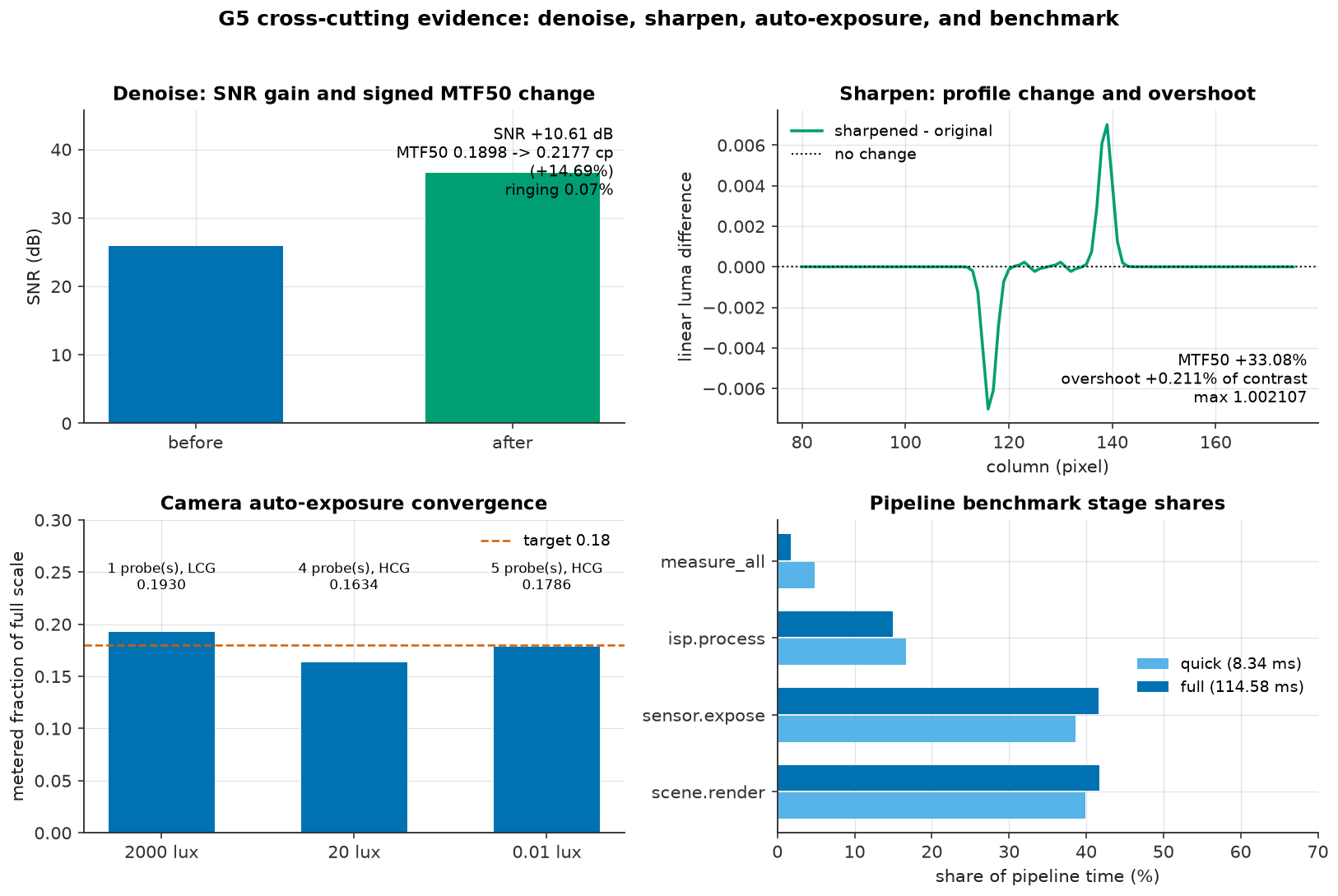 Denoise, sharpen, auto-exposure, and benchmark evidence. |
Build and test
The build and test checks prove that a fresh environment can install, lint, type-check, test, and document the package. Reproduce it from the repository root:
uv sync --all-extras
uv run pytest -q
uv run ruff check .
uv run ruff format --check .
uv run mypy src
uv run mkdocs build --strict
uv run python -c "import camsim; print(camsim.__version__)"
Expected: the suite passes, lint and formatting are clean, mypy reports no
issues under strict, the documentation builds with warnings treated as
errors, and the version prints the installed version. The executable form of
these checks is tests/test_ci_config.py plus the CI workflows, and make gate
runs the same commands locally.
Scene and optics
Status: PASS. The full report is
results/reports/g1_scene_optics.md; its four figures are
results/figures/g1_lux_normalization.png, g1_psf_mtf.png,
g1_energy_conservation.png, and g1_edge_angle.png. The report is generated
deterministically by benchmarks/g1_scene_optics.py, and
tests/test_validation_g1.py is the executable form of the gate.
Reproduce from the repository root:
uv run python benchmarks/g1_scene_optics.py
uv run pytest tests/test_validation_g1.py -v
uv run pytest tests/test_validation_g1.py tests/test_units.py \
  tests/test_spectral.py tests/test_lens.py tests/test_psf.py \
  tests/test_targets.py tests/test_propagation.py tests/test_glyphs.py -v
uv run pytest -q
uv run ruff check . && uv run mypy src
Measured results against the scene and optics tolerances:
| Check | Measured | Tolerance | Result |
|---|---|---|---|
Photometric normalization (683 * integral E(lambda) V(lambda) dlambda, dlambda in nm) |
max relative error 3.64e-16 over D65/3000 K/4000 K and 1-100,000 lux | < 1e-3 | PASS |
| Gaussian PSF MTF50, sigma = 1 px | 0.187391 cycles/pixel | within 0.01 of 0.1874 | PASS |
| Airy first zero, reference f/1.8 lens | 1.07810 px | within 1e-3 of 1.078 px; kernel matches x = pi r / (lambda N / pitch) within 1e-12 |
PASS |
| Energy through PSF + 4x box mean | max relative error 8.88e-16 | < 1e-2 | PASS |
| Slanted-edge angle recovery | max absolute error 0.0426 deg | < 0.5 deg | PASS |
| Spectral cube/unit contract and resampling | 7/7 checks behaved as required | reject mismatches; conserve energy | PASS |
| Reference lens geometry | 83.677 deg diagonal FOV; 99.733 px/deg at 1.12 um | 84 +/- 1 deg; 99.73 +/- 0.1 % | PASS |
The report records these assumptions and known limitations:
- the optics layer is a supporting model, not a calibrated lens: ideal Gaussian, Airy, and box kernels with no aberrations, wavelength-dependent PSF, polychromatic diffraction, or field-dependent blur;
- ISO 12233-style e-SFR is deferred to the metrics validation; the scene validation covers only the target/estimator edge-angle convention;
- D65 endpoint extrapolation:
colour-sciencetabulates D65 to 780 nm and camsim holds that value constant to 830 nm; V(lambda) is about 1.5e-5 at 780 nm, so the photometric effect is far below the 1e-3 tolerance; - the photometric integral covers 360-830 nm, with V(lambda) zero outside the CIE table by contract;
- the reference lens uses scalar transmittance 0.9, no vignetting, and a 83.68 deg field that rounds to the documented approximately 84 deg;
- energy conservation is a round-off-level statement for symmetric kernels with reflected borders; asymmetric kernels carry the documented 1 % budget;
- determinism is promised within one environment; PNG bytes can differ across Matplotlib/font builds, so cross-platform checks compare the reported numbers with tolerances.
Sensor and characterization
Status: PASS. The full report is results/reports/g2_sensor.md,
its machine-readable results are results/reports/g2_sensor_results.json, and
its six figures are results/figures/g2_qe_cfa_ir_cut.png, g2_ptc.png,
g2_snr_vs_irradiance.png, g2_dark_current_vs_temperature.png,
g2_lcg_hcg_comparison.png, and g2_dsnu_prnu_histograms.png. The report is
generated by examples/04_emva_characterization.py;
tests/test_preset_validation.py is the executable form of the flagship sensor
recovery check.
Reproduce from the repository root:
uv run pytest tests/test_sensor.py tests/test_noise.py tests/test_defects.py \
  tests/test_gain.py tests/test_adc.py tests/test_characterization.py \
  tests/test_preset_validation.py -v
uv run pytest -q
uv run ruff check . && uv run ruff format --check . && uv run mypy src
uv run python examples/04_emva_characterization.py
Measured results against the sensor tolerances (32 frames per level, 10 ms exposure, sensor LCG sweep with base seed 9; HCG low-to-saturation sweep with base seed 3; 16 dark frames per temperature at 0.1 s with base seed 21):
| Check | Measured | Tolerance | Result |
|---|---|---|---|
| LCG read noise | 2.0264 e- rms | 2.0 +/- 5 % | PASS |
| LCG DSNU | 0.4775 e- | 0.5 +/- 10 % | PASS |
| LCG PRNU | 0.4993 % | 0.5 +/- 10 % | PASS |
| LCG saturation capacity | 5996.8 e- | 6000 +/- 10 % | PASS |
| LCG linearity residual | 4.19e-5 | < 0.05 | PASS |
| LCG dynamic range | 69.42 dB | 30-90 dB | PASS |
| LCG system gain relative error | 0.018 % | < 2 % | PASS |
| HCG read noise | 0.7211 e- rms | 0.7 +/- 5 % | PASS |
| HCG DSNU | 0.5031 e- | 0.5 +/- 10 % | PASS |
| HCG PRNU | 0.4971 % | 0.5 +/- 10 % | PASS |
| HCG saturation capacity | 2015.3 e- | 2000 +/- 10 % | PASS |
| HCG linearity residual | 7.33e-5 | < 0.05 | PASS |
| HCG dynamic range | 68.93 dB | 30-90 dB | PASS |
| HCG system gain relative error | 0.788 % | < 2 % | PASS |
| Dark current at 65 C (differential) | 60.68 e-/s | 61.80 +/- 5 % | PASS |
| Dark current at 70 C (differential) | 99.89 e-/s | 102.17 +/- 5 % | PASS |
The report records these assumptions and known limitations:
- the characterization is simulated and EMVA 1288-style, not a certified measurement of a physical sensor;
- the flagship preset is a representative engineering design point, not a
measurement of a specific commercial part; the QE/CFA/IR-cut curves are
synthetic estimates bundled in
camsim.data; - each PTC uses one conversion-gain mode;
autois resolved once because a mixed-mode PTC has no single slope; - flat-field illumination is uniform, temperature is constant within a characterization, and the ADC is ideal and linear;
- LCG/DSNU and HCG read noise are sub-LSB (about 0.24-0.26 DN), so the fit uses the exact quantized forward model rather than a fixed 1/12 DN² correction;
- the eight-frame LCG sweep in
tests/test_characterization.pyis a robustness check with a documented 20 % DSNU waiver; the 32-frame result is the sensor validation evidence; - dark-current points below 60 C are differential measurements compressed
by the zero-charge clamp and sub-LSB ADC, so only 65 C and 70 C are
validation criteria; those agree with the differential doubling model
D(T) - D(25 C)within 1.8 % and 2.2 % under a 5 % tolerance; - determinism is promised within one environment; cross-platform runs compare tolerances, not bit patterns.
ISP
Status: PASS. The full report is
results/reports/g3_isp.md (a repository artifact, not a page in the published
docs site); its machine-readable results are
results/reports/g3_isp_results.json, and its figures are
results/figures/02_isp_stage_contact_sheet.png,
02_isp_stage_zoom.png, 02_isp_demosaic_comparison.png,
02_isp_colorchecker_delta_e.png, 02_isp_awb_gains.png,
02_isp_rccc_baseline.png, g3_delta_e.png, g3_awb_gains.png, and
g3_check_summary.png. The artifacts are generated by
examples/02_isp_stage_gallery.py; tests/test_example_02.py is the
executable form of the gate. The stage contract is described on the
ISP stages page.
Reproduce from the repository root:
uv run python examples/02_isp_stage_gallery.py
uv run pytest tests/test_example_02.py -v
uv run jupytext --to ipynb --execute notebooks/02_isp_color_fundamentals.py \
  --output /tmp/02.ipynb
The full example exits non-zero when a gate check fails; the quick smoke run is informational and always exits zero.
Measured results against the ISP tolerances (full run, 300 lux, 96 x 128 ColorChecker, 2x oversampling, flagship preset at LCG):
| Check | Measured | Tolerance | Result |
|---|---|---|---|
| ColorChecker mean ΔE2000, D65 | 0.919 | < 2.0 | PASS |
| ColorChecker mean ΔE2000, 3000 K | 3.834 | < 4.0 | PASS |
| AWB R gain relative error, D65 | 0.465 % | < 5 % | PASS |
| AWB B gain relative error, D65 | 0.443 % | < 5 % | PASS |
| AWB R gain relative error, 3000 K | 0.497 % | < 5 % | PASS |
| AWB B gain relative error, 3000 K | 0.517 % | < 5 % | PASS |
| AWB injected-cast max relative error | 0.667 % | < 5 % | PASS |
Bilinear demosaic max abs vs colour-demosaicing |
1.19e-7 | < 1e-5 | PASS |
MHC demosaic max abs vs colour-demosaicing |
2.16e-7 | < 1e-4 | PASS |
sRGB OETF max abs vs colour-science |
2.98e-8 | < 1e-7 | PASS |
| Stage-trace display reproduction max abs | 0 | < 1e-6 | PASS |
Stage-trace linear_rgb reproduction max abs (Display P3) |
0 | < 1e-6 | PASS |
| Linear pre-tone scaling with AWB and CCM max relative error | 0 | < 1e-5 | PASS |
| CCM pre-clamp minimum on linearity data | 0.0248 | > 0 | PASS |
| LSC flat-field residual after correction | 0.618 % | < 2 % | PASS |
| Denoise SNR gain | 13.06 dB | > 3 dB | PASS |
| Denoise edge-contrast relative change | 4.3e-5 | < 10 % | PASS |
| Sharpen edge-contrast gain | 0.587 | > 0 | PASS |
| Sharpen positive overshoot | 0.117 | > 0 | PASS |
| RCCC baseline output | (64, 64, 3), finite |
3 channels | PASS |
The ColorChecker criterion now passes because the shipped preset's CFA curves were re-authored as synthetic conventional Bayer bands centred near 448 nm (blue), 542 nm (green), and 610 nm (red) with moderate out-of-band leakage and peak transmittance 0.86-0.91 (R 0.905, G 0.903, B 0.864). The superseded broad, nearly collinear curves had a red/green correlation of 0.940 and left a 45.6 % Luther-condition residual, so no 3x3 matrix could colour-correct them. The conventional bands reduce the correlation to 0.187, the projection condition number to 1.56, and the Luther-condition residual to 12.6 %, and the in-sample CCM fit RMS is about 0.008 linear RGB at both illuminants. The ΔE thresholds (2.0 / 4.0) were not changed. The 3000 K mean is 3.834, 4.14 % below the 4.0 limit; the check is mean-only, with per-patch maxima reaching 13.208 (blue) and 11.077 (purplish blue). The fit remains in-sample: it measures calibration-scene representability, not held-out generalisation or colour constancy.
The report records these assumptions and known limitations:
- the validation is simulated; it is not a certified ISO 12233 or EMVA 1288 measurement, and the preset is a representative engineering design point;
- the CCM is fitted and evaluated in-sample on the same 24 patches; it measures calibration-scene representability, not held-out generalisation or colour constancy;
- the ColorChecker CCM run uses manual analytic perfect-diffuser AWB gains so the row-sum CCM is neutral-preserving; the default gray-world estimator is validated separately on neutral flat fields and under an injected cast;
- formal ISO 12233-style e-SFR and MTF50/MTF20 live in the metrics and consolidated validation; the independent metrics harness measures them, while the ISP validation reports edge-contrast preservation and positive overshoot;
Camera.auto_expose()convergence is consolidated evidence; the ISP validation calibrates exposure explicitly from a probe;- quick mode is not validation evidence;
--quickwritesg3_isp_results_quick.jsonand never overwrites the committed JSON or Markdown; - DPC and BLC are evidenced by the focused unit tests
tests/test_isp_dpc.pyandtests/test_isp_blc.pyrather than re-measured in the ISP validation payload; - determinism is promised within one environment; PNG bytes can differ across Matplotlib/font builds, so cross-platform checks compare numbers.
Metrics
Status: PASS. The full report is
results/reports/g4_metrics.md (a repository artifact, not a page in the
published docs site); its machine-readable results are
results/reports/g4_metrics_results.json, and its figures are
results/figures/03_mtf_curves.png, 03_snr_vs_lux.png,
03_delta_e_heatmap.png, 03_acutance_vs_blur.png, g4_mtf_curves.png,
g4_snr_vs_lux.png, g4_delta_e_heatmap.png, g4_acutance_vs_blur.png, and
g4_check_summary.png. The artifacts are generated by
examples/03_measure_iq.py; tests/test_example_03.py is the executable form
of the gate. The measurement itself is shared by the example and the tests
through camsim.characterization.measure_g4. The definitions and limitations
are described on the Metrics page.
Reproduce from the repository root:
uv run python examples/03_measure_iq.py
uv run pytest tests/test_metrics_mtf.py tests/test_metrics_snr.py \
  tests/test_metrics_color.py tests/test_metrics_summary.py \
  tests/test_metrics_independence.py tests/test_example_03.py -v
uv run jupytext --to ipynb --execute notebooks/03_measuring_iq.py \
  --output /tmp/03.ipynb
The full example exits non-zero when a gate check fails; the quick smoke run is informational and always exits zero.
Measured results against the metrics tolerances (full run: 256 x 256 slanted edge, 8x analysis oversampling, 64 x 64 spatial SNR patches, a 32-frame temporal stack, and a 96 x 128 synthetic ColorChecker-like chart):
| Check | Measured | Tolerance | Result |
|---|---|---|---|
| MTF50 vs analytic Gaussian sigma=1 px (absolute error, cp) | 6.338e-05 | <= 0.00474782 | PASS |
| MTF20 vs analytic Gaussian sigma=1 px (absolute error, cp) | 0.0001023 | <= 0.00671124 | PASS |
| MTF50 angle spread, Gaussian (relative) | 0.00150161 | < 0.05 | PASS |
| MTF50 vs analytic Box width=4 px (absolute error, cp) | 0.0001755 | <= 0.00387929 | PASS |
| MTF20 vs analytic Box width=4 px (absolute error, cp) | 0.0004548 | <= 0.00500934 | PASS |
| MTF50 angle spread, Box (relative) | 0.0104204 | < 0.05 | PASS |
| MTF50 vs analytic Airy f/4 (absolute error, cp) | 0.0001569 | <= 0.00521839 | PASS |
| MTF20 vs analytic Airy f/4 (absolute error, cp) | 0.0002694 | <= 0.00804524 | PASS |
| MTF50 angle spread, Airy f/4 (relative) | 0.00492637 | < 0.05 | PASS |
| MTF50 vs analytic Airy f/8 (absolute error, cp) | 0.0001242 | <= 0.00311163 | PASS |
| MTF20 vs analytic Airy f/8 (absolute error, cp) | 5.557e-05 | <= 0.00452605 | PASS |
| MTF50 angle spread, Airy f/8 (relative) | 0.00151456 | < 0.05 | PASS |
| MTF50 noise robustness, Gaussian (relative change) | 0.0118359 | < 0.05 | PASS |
| MTF curve DC normalization (max abs error) | 0 | < 1e-09 | PASS |
| MTF curve range [0, 1] (max violation) | 0 | < 1e-09 | PASS |
| MTF curve monotonicity, Gaussian full band (max rise) | -0.0001296 | < 1e-09 | PASS |
| MTF curve monotonicity, box main lobe (max rise) | -0.0004265 | < 1e-09 | PASS |
| SNR spatial per-channel agreement (max abs error, dB) | 0.0835339 | < 0.5 | PASS |
| SNR spatial luma agreement (abs error, dB) | 0.0156268 | < 0.5 | PASS |
| SNR temporal vs known noise (abs error, dB) | 0.0179613 | < 0.5 | PASS |
| SNR temporal fixed-pattern rejection (temporal minus spatial, dB) | 14.0558 | > 5 | PASS |
| SNR mono path agreement (abs error, dB) | 0.009943 | < 0.5 | PASS |
| DeltaE76 vs colour-science (max abs error) | 0 | < 1e-09 | PASS |
| DeltaE2000 vs colour-science (max abs error) | 0 | < 1e-09 | PASS |
| DeltaE identity (max abs error) | 0 | < 1e-12 | PASS |
| Sharma CIEDE2000 published pairs (max abs error) | 4.95e-05 | < 0.0001 | PASS |
| measure_all RGB chart completeness (colour + SNR) | 1 | = 1 +/- 0 | PASS |
| measure_all edge layout completeness (MTF + acutance) | 1 | = 1 +/- 0 | PASS |
| measure_all MONO report (SNR without colour) | 1 | = 1 +/- 0 | PASS |
| measure_all JSON serialization (NaN -> null) | 1 | = 1 +/- 0 | PASS |
| metrics import independence (forbidden modules absent) | 1 | = 1 +/- 0 | PASS |
The analytic MTF reference is camsim.optics.psf.psf_mtf, the exact discrete
transfer function of the same kernel, evaluated on a dense frequency grid; the
metric and the reference share no measurement code. The crossing budget is 2 %
of the reference plus a 1e-3 cycles/pixel absolute floor. The eight analysis
samples per pixel remove the roughly 2 % near-diffraction-limited MTF50 bias
that four samples per pixel carries. The SNR references are the generating
means and sigmas, not the estimator's own sample statistics: the spatial
channels use SPATIAL_MEANS/SPATIAL_SIGMA, luma uses the weighted generating
mean and quadrature-weighted sigma (the channel draws are independent), the
temporal check uses TEMPORAL_MEAN/TEMPORAL_SIGMA, and mono uses the
generating R-channel constants. The sample-statistics consistency diagnostic is
zero by construction and is recorded in snr.consistency as a non-gate
diagnostic, not as evidence. The 14.06 dB gap between the temporal and
single-frame spatial estimates demonstrates fixed-pattern rejection. Delta-E is
compared with colour.delta_E(method="CIE 1976"/"CIE 2000") on 43 pairs,
including the 34 published Sharma et al. (2005) CIEDE2000 pairs; agreement is at
floating-point round-off, and the published four-decimal values agree to
4.95e-05.
The gallery also plots a sensor/ISP flat-field SNR sweep from 25 to 3200 lux at
a fixed 10 ms exposure (64 x 64 pixels, PDAF disabled, linear
RenderedImage.linear_rgb), where luma SNR rises from 12.45 to 35.16 dB. The
committed results/reports/g4_metrics_results.json records the exact levels,
per-channel values, and clipped fractions in its lux_sweep section with
gate_evidence: false; the sweep is an illustration, not a validation check.
The report records these assumptions and known limitations:
- the validation is simulated; it is not a certified ISO 12233 e-SFR measurement, and the implementation follows the standard's principles without claiming conformance;
- the analytic PSFs are ideal Gaussian, box, and Airy kernels: no aberrations, field-dependent blur, or wavelength-dependent PSF;
- the Airy and box validation cases use 8x oversampling because four carries about a 2 % MTF50 bias for near-diffraction-limited systems;
- Airy f/2.8 is a diagnostic only: its MTF never reaches 0.20 inside Nyquist and its MTF50 sits closest to the band edge, so it is reported with its documented bias and excluded from the thresholds;
- the width-4 box transfer function is
|sinc(4 f)|, whose sidelobe after the zero at 0.25 cycles/pixel is physical, so monotonicity is enforced over the main lobe only; - the SNR cases use Gaussian noise in linear light, not Poisson shot noise from the sensor, which isolates the estimator from the sensor model;
- the synthetic ColorChecker-like chart is built from the spectrally computed reference Lab plus a deterministic perturbation; it is a measurement vehicle, not a camera render, and its delta-E is not a camera colour-accuracy claim;
- an ideal synthetic edge has no finite MTF50/MTF20; the report records
that as
nulland never invents a crossing; - quick mode is not validation evidence;
--quickuses smaller grids, writesg4_metrics_results_quick.json, and never overwrites the committed JSON or Markdown; - determinism is promised within one environment; PNG bytes can differ across Matplotlib/font builds, so cross-platform checks compare numbers.
Validation report conventions
Each validation report contains:
- the exact commands and environment used (OS, Python, dependency versions, configuration hash, and seeds);
- the metric, threshold, and measured value for every check;
- figures under
results/figures/where a plot is clearer than a number; - known limitations and assumptions, including any datasheet value that is an engineering estimate rather than a vendor measurement;
- the pass/fail verdict and the commit it applies to.
A report is appended to this page only when it has been regenerated against the current commit. Changes that invalidate a report require a re-run.
Consolidated evidence
The consolidated report is results/reports/validation_report.md. It binds the
area reports and machine-readable results by SHA-256, so a validation artifact
cannot change without regenerating the report, and the report records the
artifact regeneration actually performed.
Cross-cutting evidence
These criteria span the pipeline and the engineering process and are measured
by benchmarks/g5_validation_report.py with direct calls to the public stages
and metrics. The full derivation and raw values are in the report.
| Check | Measured | Bound | Result |
|---|---|---|---|
| Denoise luma SNR gain | +10.61 dB (25.946 → 36.558 dB) | > 0 dB | PASS |
| Denoise MTF50 change | 0.189840 → 0.217722 cycles/pixel (signed +14.69%) | |change| ≤ 20% | PASS |
| Denoise edge ringing | overshoot +0.07%, undershoot 0.07% of contrast | each ≤ 1% | PASS |
| Sharpen MTF50 gain | 0.187328 → 0.249291 cycles/pixel (+33.08%) | after > before | PASS |
| Sharpen positive overshoot | max normalized profile 1.002107 (+0.21% of contrast) | > 1.001 | PASS |
| Camera AE convergence | 2000/20/0.01 lux: 1/4/5 probes, metered 0.1930/0.1634/0.1786 | converged, |metered − 0.18| ≤ 0.02 | PASS |
| Camera AE physical limits | exposure ≤ 100 ms, analog ≤ 24 dB, digital 1.00–44.34× | preset windows | PASS |
| RCCC baseline | (32, 48, 3), finite, R = 0.25, G = B = 0.60, linear | shape / DC / linearity | PASS |
| Determinism | RAW and rendered arrays bit-identical | same seeds, same environment | PASS |
| Metrics import independence | sensor/ISP/scene/optics absent from sys.modules |
no forbidden imports | PASS |
| CLI render → measure | both commands exit 0; MTF50 0.433778 cycles/pixel; acutance 0.0768 | finite report | PASS |
| Quick-mode isolation | no *_quick* artifacts in results/reports |
full-run JSON only | PASS |
| Examples headless (local) | 4/4 pass, 1.96–14.64 s each | 300 s per example | PASS |
| Notebooks headless (local) | 3/3 pass, 2.53–14.79 s each | 120 s per notebook | PASS |
The denoise MTF50 measurement rises rather than falls: the full-strength bilateral filter suppresses the noise floor and steepens the transition. The criterion is two-sided (absolute change ≤ 20 %), so both smearing and invented contrast fail, and the signed change is reported. A separate edge-ringing check puts the overshoot and undershoot well below 1 % of contrast. The sharpen overshoot is small but measurable (0.21% of edge contrast), as expected at radius 1. The RCCC result is a shape, constant-preservation, and linearity check only: its clear channel is a documented luma placeholder, and the Bayer colour and MTF checks do not apply.
Engineering checks
| Check | Recorded result |
|---|---|
uv run pytest -q |
1775 passed |
uv run pytest --cov=camsim --cov-fail-under=90 |
1775 passed; 91.73% subject-module coverage (required 90%) |
uv run pytest --cov=camsim --cov-config=coverage-whole.rc |
1775 passed; 83.55% whole-package coverage including viz |
uv run ruff check . / ruff format --check . |
clean; 143 files formatted |
uv run mypy src |
no issues in 69 source files |
uv run mkdocs build --strict |
documentation built |
uv run python benchmarks/benchmark_pipeline.py --quick |
8.34 ms total (128 × 128) |
uv run python benchmarks/benchmark_pipeline.py |
114.58 ms total (512 × 512) |
uv run python benchmarks/benchmark_pipeline.py --large |
453.90 ms total (1024 × 1024, 1× oversampling) |
uv build |
wheel and sdist |
CI runs the same commands on Ubuntu and macOS across Python 3.11, 3.12, and
3.13, and adds examples and notebooks jobs. The GitHub CI matrix and the
Pages deployment pass.
The runners enforce the runtime budgets as subprocess timeouts and fail fast:
| Sweep | Runner | Per-item budget | Local result |
|---|---|---|---|
| Examples 01–04 | benchmarks/run_examples.py |
300 s | all pass; 2.07–14.62 s |
| Notebooks 01–03 | benchmarks/run_notebooks.py |
120 s | all pass; 2.57–14.82 s |
make notebooks and make figures invoke those runners. The per-item times
are recorded in results/reports/examples_timings.json and
results/reports/notebooks_timings.json and repeated in the consolidated
validation report. Quick-mode artifacts are smoke tests and never overwrite the
committed full-run JSON or Markdown.
See Datasheet mapping for how preset values are traced to public specifications.