Ablations
Question
Which of four basic design choices matters under a fixed, reduced CIFAR-10 budget: augmentation, BatchNorm, residual connections, and the learning-rate schedule?
Protocol
- CIFAR-10 reduced split: 10,000 train / 2,000 validation, 10,000 test.
- Seed 42; 8 epochs; batch 128; AdamW 1e-3; weight decay 5e-4.
- Residual CNN with widths 32/64/128, dropout 0.2.
- Each pair changes exactly one knob; the shared
_base.yamlmakes that structural.
| Pair | On | Off |
|---|---|---|
| Augmentation | random crop + horizontal flip | tensor + normalize only |
| BatchNorm | norm: batch |
norm: none |
| Residual | residual: true |
residual: false |
| Schedule | cosine | constant |
Model design
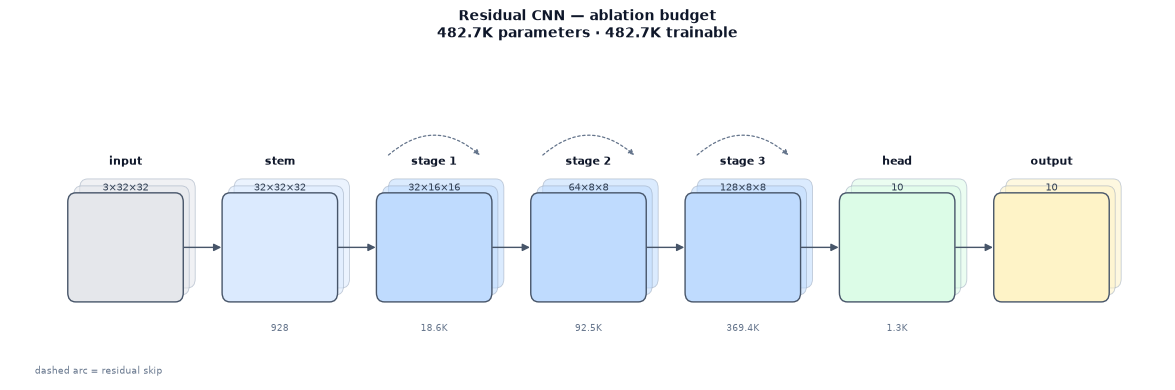
All eight configs share this small residual CNN. A pair changes exactly one of the annotated choices—augmentation, BatchNorm, residual connections, or the schedule—while the stage layout and parameter budget stay fixed.
Result
The four “on” configs share the base recipe, so their identical 67.92% result is the shared baseline for each pair.
| Pair | On | Off | Difference | CI overlap |
|---|---|---|---|---|
| Augmentation | 67.92% | 71.06% | off +3.14 pp | none |
| BatchNorm | 67.92% | 48.55% | on +19.37 pp | none |
| Residual | 67.92% | 68.60% | off +0.68 pp | substantial |
| Schedule | 67.92% | 59.44% | cosine +8.48 pp | none |
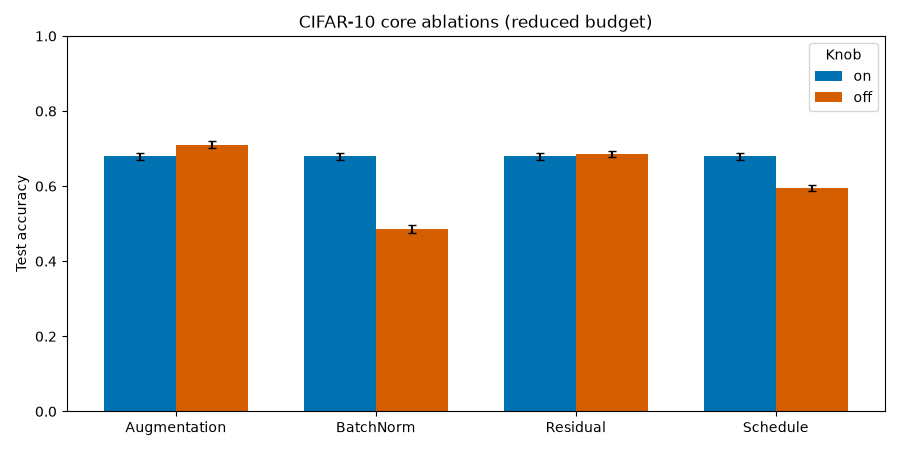
Paired bootstrap (on − off):
| Pair | Difference | 95% CI |
|---|---|---|
| Augmentation | −3.14 pp | −3.90 to −2.42 pp |
| BatchNorm | +19.37 pp | +18.30 to +20.42 pp |
| Residual | −0.68 pp | −1.36 to +0.03 pp |
| Schedule | +8.48 pp | +7.60 to +9.40 pp |
The comparison records per-run accuracy, macro F1, parameter count, training
time, and latency, with the per-run bootstrap interval in each summary.json.
The augmentation result (off better on this reduced budget) is measured, not a
recommendation.
What to notice
- One knob per pair. A test asserts that the paired configs differ only in the intended field.
- Same data and budget. The subset limits are part of the data fingerprint.
- Test evaluation happens after training. All eight training runs finish before test is evaluated.
- Compute is recorded. A difference is read against training time, not just accuracy.
Caveat
This is a reduced-budget study on one seed, not a definitive statistical claim. Overlapping intervals are not evidence of no effect, and a single seed cannot separate a small effect from seed noise. The study demonstrates the workflow and the honest reporting, not a universal ranking of the techniques.