CIFAR-10 scratch baseline
Question
How well can a small residual CNN trained from scratch do on CIFAR-10 with a plain, reproducible recipe — and does the library reproduce the reference result without special-case code?
This is the reference baseline for the project. It is deliberately a standard recipe, not a state-of-the-art submission: the point is a trustworthy, config-driven training pipeline that reports its own behavior honestly.
Protocol
| Component | Value |
|---|---|
| Data | CIFAR-10, 45,000 train / 5,000 validation / 10,000 test |
| Split | plain random, seed 42 |
| Model | residual_cnn, 3→64 stem, four stages, widths 64/128/256/512 |
| Parameters | 7,827,786 |
| Augmentation | flip, random crop (32, padding 4), mild color jitter, random erasing |
| Optimizer | Adam, lr 1e-3, weight decay 5e-4 |
| Schedule | cosine, no warmup, no gradient clipping |
| Budget | 50 epochs, batch 128, early stopping patience 10 |
| Device | Apple M3 Max MPS |
Model design
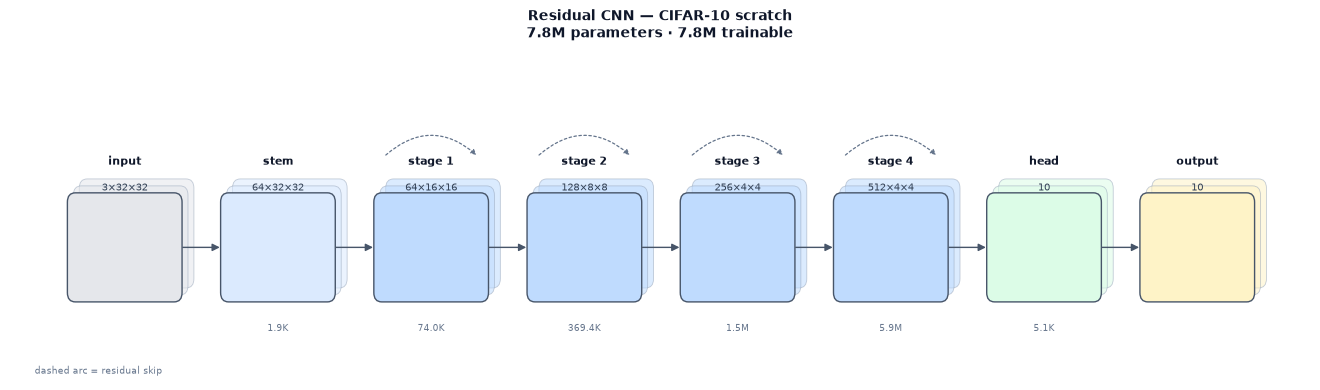
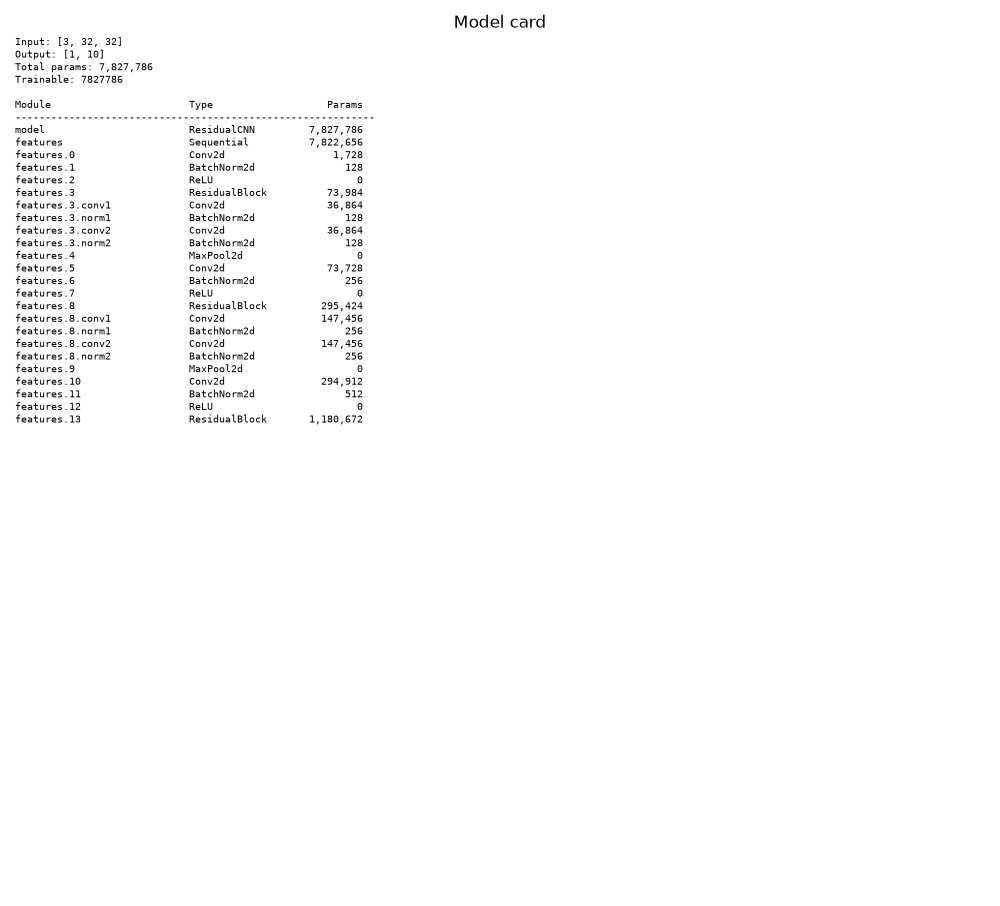
The reference preset is a 7.8M-parameter residual CNN: a 3→64 stem, four residual stages at widths 64/128/256/512, global average pooling, dropout 0.3, and a linear head. The schematic shows the stage shapes and parameter counts; the model card in the report lists every module.
Result
| Field | Value |
|---|---|
| Best validation accuracy | 92.78% (epoch 46) |
| Test accuracy | 92.25% |
| Test macro F1 | 92.26% |
| Test top-5 accuracy | 98.90% |
| Test accuracy 95% CI | 91.76–92.77% |
| Test NLL | 0.2894 |
| Calibration ECE | 0.0434 |
| Latency | 2.08 ms/image on MPS |
| Training time | 1,338 s (22.3 min) |
Reference: 92.42% validation / 92.61% test on MPS, seed 42. The test difference is −0.36 percentage points; the validation difference is +0.36. The ≥90% gate is met. No tuning was performed against the test split.
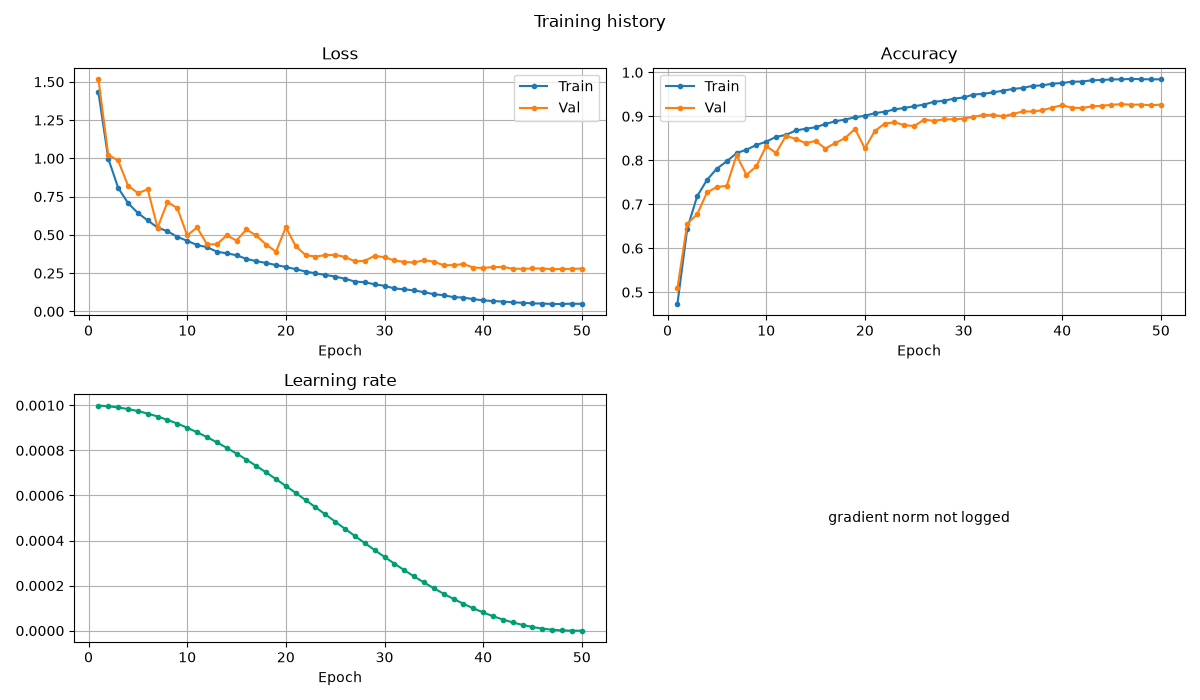
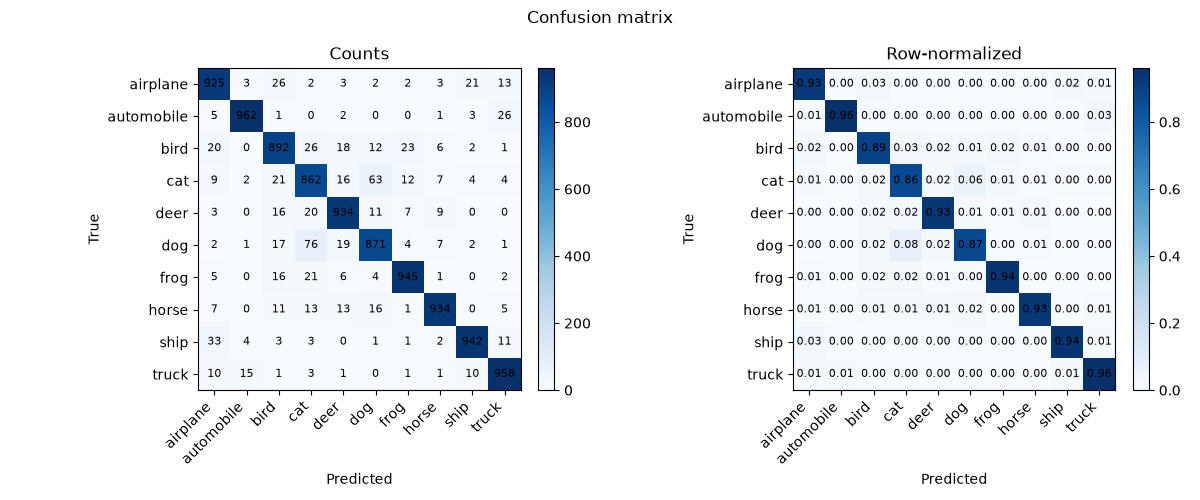
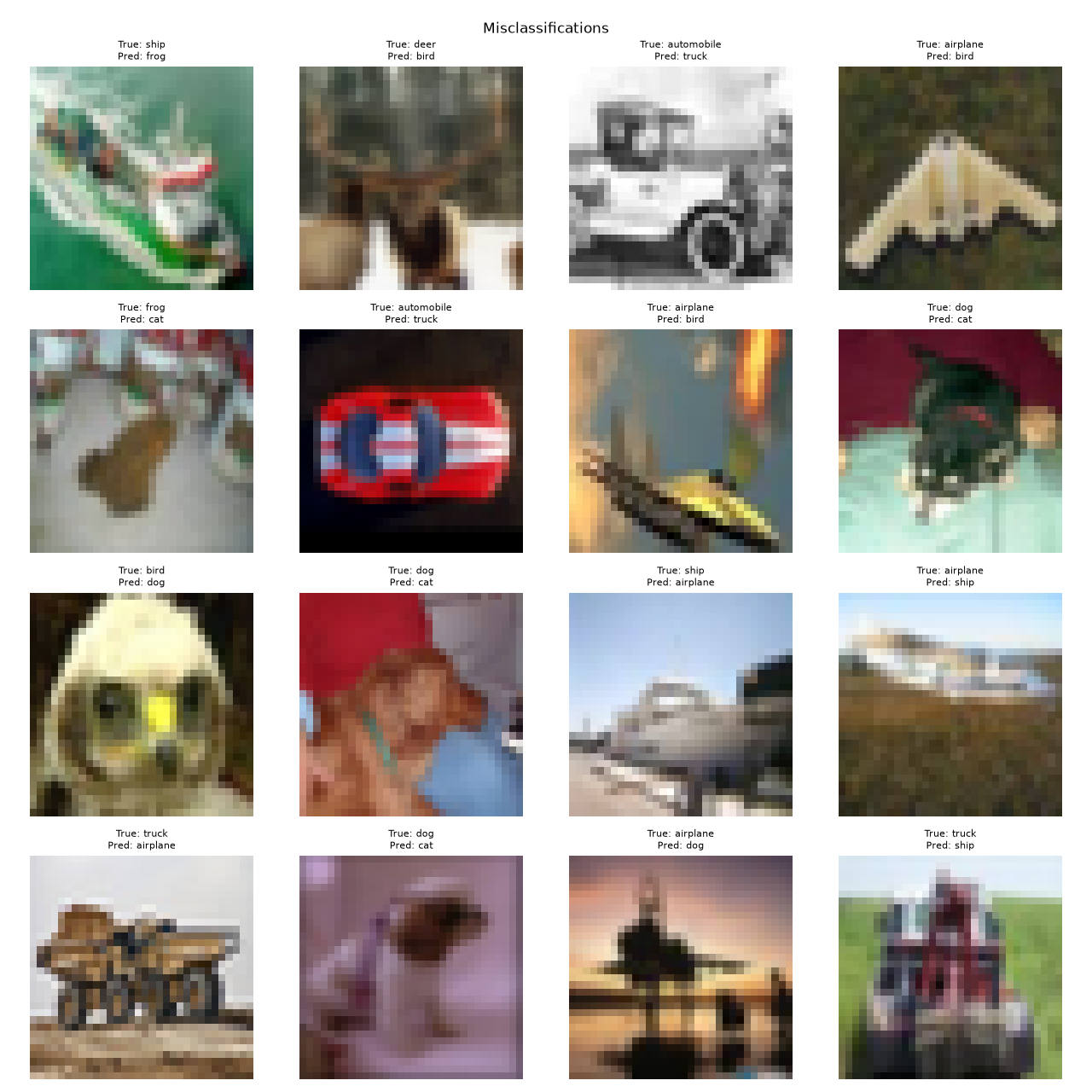
Artifacts
The run directory contains best.pt, last.pt, the resolved config,
environment and git state, the data contract and fingerprints, history,
metrics, test predictions, figures, and self-contained HTML/Markdown reports.
Checkpoints stay local; committed result packaging lives under results/.
What to notice
- One YAML file describes the experiment. The model is a generic
residual_cnnpreset, not a CIFAR-specific class. - The test split is isolated.
Trainer.fit()never iterates the test loader; test is evaluated once from the best validation checkpoint. - The result is reproducible. Seed, environment, git state, and data fingerprint are recorded in the run.
- The report is honest. It shows calibration, per-class metrics, and the error gallery alongside accuracy.
Caveat
This is a reference reproduction on one Apple Silicon machine, not a state-of-the-art benchmark. CIFAR-10 is saturated; the interesting part is the pipeline, the discipline, and the diagnostics.